
Viewing Today’s Financial World Through the Lens of Credit Analysis
By Kevin Tanner | Chairman | CEO | Chief Investment Officer
Throughout this Latticework Series, I have been trying to describe the financial world around us by viewing it through the lenses of different disciplines. Behavioral finance helped explain why investors become captivated by narratives. Neuroscience explored why our brains are predisposed to those behaviors. Microeconomics examined how competition shapes the economics of businesses. Financial statement analysis showed how today’s accounting often reflects yesterday’s economic decisions. In this essay, we’ll look at that same world through the lens of credit analysis.
Each discipline directs our attention toward different questions. The facts may remain unchanged, but the perspective alters what we can learn. Behavioral finance draws attention to the ways emotion and cognitive bias influence decisions. Microeconomics focuses on competition, incentives, pricing power, and the allocation of scarce resources. Financial statement analysis asks how economic events flow through balance sheets, income statements, and cash flow statements over time.
Credit analysis offers yet another perspective. It directs attention toward the cost and availability of capital, the strength of balance sheets, the durability of cash flows, and the contractual obligations that must be met before shareholders receive anything at all. By looking through this lens, we’re not necessarily seeking better answers than other disciplines can provide. We’re asking different questions – the answers to which may reveal aspects of the financial world that are otherwise easy to overlook.
Those questions have become particularly relevant today. The cost of capital has increased materially from the extraordinarily low levels that prevailed for much of the period following the Global Financial Crisis through the pandemic. Government borrowing requirements are growing at an unsustainable pace. On top of that, the current AI buildout represents one of the largest, if not the largest, infrastructure investment programs in U.S. history, inviting comparisons to the railroad buildout of the nineteenth century, the Interstate Highway System, and the Apollo space program. Corporations that once financed investment almost entirely from internally generated cash flow are increasingly turning to the bond market, private credit, project finance, joint ventures, and other forms of outside capital. At the same time, credit spreads across much of the market remain historically tight, even as the riskiest corners have begun showing signs of strain.
To understand what these developments may mean, it helps to begin with the most basic distinction in finance. When an investor buys a share of stock, the investor acquires a residual claim on a business. Employees are paid, suppliers are paid, taxes are paid, interest and principal are paid. Whatever remains belongs to the shareholders.
Debt is different. A lender does not typically participate in the upside a successful business may create. Rather, the lender receives a contractual obligation: interest will be paid on specified dates, and principal will be returned according to agreed-upon terms.
That difference shapes the way equity and credit investors approach the same business. An equity investor may ask how large the opportunity could become, how quickly revenues might grow, whether margins can expand, and how valuable the company might ultimately be. Credit investors start from a different place. What obligations must be paid? What cash flows are available to meet them? How much debt already exists? When does it mature? What assets collateralize the borrowing? What restrictions are in place to protect lenders? Most importantly, what could prevent the borrower from fulfilling its contractual credit obligations?
Equity investors naturally focus on what may go right. Credit analysis starts by asking what could go wrong.
This doesn’t make credit analysis inherently pessimistic. A lender isn’t predicting failure any more than an insurer is predicting an accident. The objective is to identify the risks, determine whether they can be absorbed, and decide what level of compensation is sufficient for bearing them.
That compensation becomes the borrower's cost of debt. It is one important component of the broader cost of capital, but not the only one.
Debt, however, is only one source of capital. Equity capital also has a cost, even though that cost is neither contractual nor as readily observable. When a company issues shares, it receives capital today in exchange for giving new shareholders a permanent proportional claim on the future economics of the business.
Warren Buffett has long approached this tradeoff in especially intuitive terms by thinking of stock as a form of currency. What matters is not simply how much capital a company receives, but how much intrinsic value it gives up in return. Issuing $1 of stock to receive less than $1 of intrinsic value destroys value for continuing shareholders just as surely as overpaying for any other asset. Equity may have no coupon and no maturity date, but that doesn’t make it free.
For now, credit provides the clearest place to begin because the price and terms of debt are more explicit. Interest rates can be observed. Credit spreads can be compared. Maturities, covenants, collateral, and repayment obligations can be identified. Through them, we can see more directly why capital is never truly free.
Capital is often discussed as though it were simply available whenever an attractive opportunity appears. In reality, capital is supplied by someone. A household saves rather than consumes. A pension fund invests assets today to meet obligations extending decades into the future. A bank accepts deposits and makes loans. An insurance company invests premiums it may not need to pay out for decades. An investor buys a bond instead of holding cash or purchasing another asset.
Each provider of capital gives something up. At a minimum, the provider gives up the ability to use that money somewhere else. The longer the commitment, the greater the uncertainty. The less liquid the investment, the more difficult it may be to exit. The weaker the borrower, the greater the possibility of loss.
Capital therefore has a cost for the same reason labor, energy, land, and raw materials have prices. It is scarce, it has competing uses, and those who supply it expect to be compensated.
The simplest starting point is usually described as the risk-free rate. In practice, U.S. Treasury securities are commonly treated as the benchmark because the federal government is considered unlikely to default on obligations denominated in its own currency. Even this so-called risk-free rate, however, is not a single number. Treasury securities mature at different times, and the compensation required to lend overnight is not typically the same as the compensation required to lend for thirty years.
The short end of the yield curve is largely determined by Federal Reserve policy. Longer-term yields reflect expectations about what short-term rates will be in the future, economic growth, inflation, fiscal conditions, and the additional compensation investors demand for committing capital for extended periods. That additional compensation is generally referred to as the term premium.
A lender who commits money for thirty years gives up far more flexibility than one who makes a 90-day loan. Interest rates may change. Inflation may surprise. More attractive opportunities may emerge. Fiscal policy may deteriorate. The supply of competing securities may increase. A lot can change over several decades that cannot be known at the time the investment is made. The term premium compensates investors for bearing that long-duration uncertainty and interest rate risk.
Inflation is related, but it is not identical. Part of a nominal bond yield reflects the inflation investors expect over the life of the bond. Investors may also demand additional compensation for the risk that actual inflation will materially differ from those expectations. That inflation risk contributes to the compensation required for holding long-duration nominal debt, but the term premium reflects a broader set of uncertainties than inflation alone.
Beyond the Treasury rate, most borrowers must pay a credit spread. This is the additional yield investors demand for assuming the risk that a corporation, municipality, household, or other borrower might fail to fulfill its contractual loan obligations.
Credit spreads vary because borrowers differ. A company with stable recurring revenue, modest leverage, substantial liquidity, and few near-term maturities should usually be able to borrow at a lower spread than a company with a more cyclical business model, heavy leverage, limited liquidity, and large refinancing needs. Lenders should demand more compensation from the weaker borrower for the greater possibility of loss.
Other premiums may also matter. A security that cannot be traded easily may require a liquidity premium. A structure that exposes lenders to early repayment, extension, weak or no collateral, or unfavorable contractual options may require additional compensation. The final borrowing cost reflects many separate judgments layered on top of one another.
None of these premiums are fixed in the open market. They change as conditions, expectations, and investor behavior change.
When investors are confident, capital often becomes plentiful and spreads narrow. Lenders accept weaker covenants, longer maturities, less collateral, and lower compensation. When confidence deteriorates, the process reverses. Spreads widen. Documentation strengthens. Amortization increases. Collateral expectations tighten. Some borrowers may discover that capital isn’t just more expensive; it may no longer be available on terms that allow for profitable deployment.
The availability of capital and the price of capital are related, but they are not the same thing. Sometimes capital remains plentiful but becomes more expensive. At other times, quoted borrowing costs appear reasonable while the market quietly becomes less willing to finance weaker borrowers. The most consequential environments often emerge when lenders begin adjusting both price and terms.
This is one reason credit analysis focuses on more than a company’s current interest expense. A business may appear comfortably financed today because its debt was issued years ago at low fixed rates. The more important question may be what happens when that debt matures and must be refinanced.
Refinancing is not a formality. It is a new capital-allocation decision made under whatever conditions prevail at the time. A company that borrowed at 3% may eventually need to refinance at 6%, 8%, or more. Even if the business remains profitable, the higher financing cost reduces the cash available to shareholders, limits management’s flexibility, and may render previously attractive investments uneconomic. If the business model requires continuous access to external capital, the consequences can become even more significant.
This is the point at which credit ceases to be merely descriptive and becomes causal.
Deteriorating credit quality doesn’t just tell us that a company’s economics have weakened. It can weaken them further. Higher borrowing costs reduce free cash flow. Lower free cash flow can lead to ratings downgrades. Downgrades can shrink the pool of potential lenders. A smaller lender base can require higher spreads, more collateral, or stricter covenants. Those changes can force reductions in investment, asset sales, dividend cuts, or new issuance of equity. The financing structure can change the business it was originally created to support.
A recent AI infrastructure project illustrates how quickly this mechanism can become self-reinforcing. The underlying mechanism is far more important than the identity of the company involved. After the project sponsor's credit rating fell below a specified contractual threshold, it became subject to approximately $7 billion of additional collateral requirements. The downgrade didn’t just increase the interest rate on future borrowings. It immediately required billions of dollars of capital to be committed in support of the project itself, reducing financial flexibility and changing the economics of the investment.
The consequences don’t necessarily end there. After the recent downgrade, the borrower's rating stood at the lowest investment-grade level. A further downgrade below that threshold could materially reduce the pool of institutions willing or permitted to lend, increase borrowing costs even further, trigger additional contractual protections, and further increase the company's cost of capital. The resulting reduction in financial flexibility could itself place additional pressure on the company's credit profile. Credit quality would no longer simply describe the economics of the business. It would begin influencing them.
We have encountered this kind of feedback loop before in the Latticework Series. George Soros used the term reflexivity to describe situations in which market perceptions influence behavior, behavior changes fundamentals, and the altered fundamentals feed back into market perceptions. Credit markets are especially fertile ground for this kind of process. Narrow spreads and easy financing encourage borrowing. Additional borrowing changes balance sheets. Changing balance sheets alter credit risk. Credit risk then influences spreads and the future availability of financing. The effect can be stabilizing for long periods and destabilizing when the direction reverses.
Hyman Minsky approached the same broad phenomenon from another direction. He argued that extended periods of stability tend to change behavior. As memories of past losses fade, borrowers and lenders become more comfortable with leverage. Financing structures gradually migrate from those that can be supported by current cash flows toward those that depend increasingly on refinancing, rising asset values, or favorable capital-market conditions. Stability does not merely precede instability. It can help create the conditions that make instability possible.
This does not mean every period of easy credit must end in crisis. Nor does it require us to predict a “Minsky moment.” The more useful takeaway is that financing structures evolve. What appears safe under one cost-of-capital regime may look very different under another.
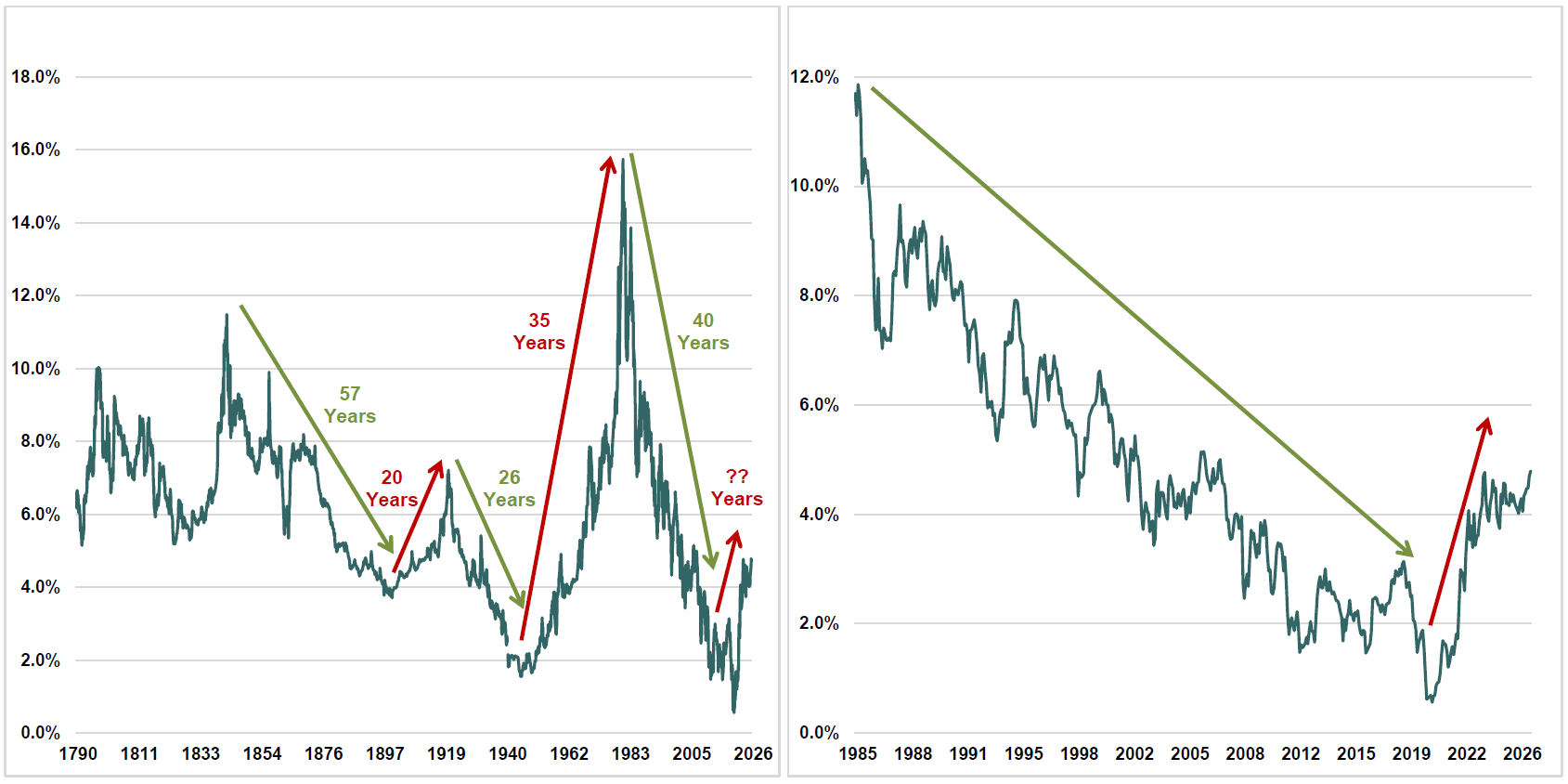
This insight is especially relevant because the investment assumptions shaping today’s capital markets continue to be influenced by one of the most unusual interest rate environments in financial history. Interest rates have always moved in long secular cycles. The great bond bear and bull markets of history have often lasted for decades, reflecting changes in inflation, monetary regimes, demographics, fiscal policy, savings behavior, and confidence in government obligations. The forty-year decline in U.S. interest rates that began in the early 1980s continues to profoundly influence nearly every corner of finance. The two charts below in Figure 4 place today's interest rate environment in its proper historical context and show how the period between the Global Financial Crisis and the pandemic trough culminated in the lowest long-term interest rates in modern U.S. history.
Figure 4: 10-Year Treasury Yield - From 1790-2026 and 1985-2026
Source: FactSet, Bianco Research, SaratogaRIM. See Disclosures.
The charts also illustrate how our perception of "normal" interest rates depends heavily on the reference point we choose. Viewed over centuries rather than decades, it is the extraordinarily low levels reached between the Global Financial Crisis and the pandemic trough – not today's rates – that appear unusual. If the pandemic trough is our reference point, today's interest rates seem high. If two centuries of history are our reference point, it is the pandemic trough that stands out as the anomaly.
In response to the collapse of the financial system and the weak recovery that followed, the Federal Reserve held short-term rates near zero for extended periods and purchased enormous quantities of longer-term securities. These policies were intended to support economic recovery, stabilize financial markets, and lower borrowing costs. They also created an environment in which the cost of capital was suppressed for so long that it eventually came to be viewed as normal.
Behavioral finance refers to this tendency as anchoring. We naturally anchor our expectations to prior experience, even when that experience may no longer provide an appropriate guide to the future. Over time, what we experience becomes incorporated into the mental models we use to understand how the world works – including our assumptions about what constitutes a "normal" interest rate.
The history of professional interest rate forecasts provides another striking illustration. Throughout much of the great bond bull market, forecasters repeatedly expected long-term interest rates to rise, even as realized yields continued their decades-long decline. At the pandemic trough – the culmination of that extraordinary bull market in bonds – the secular direction of interest rates finally reversed. As inflation surged and yields moved sharply higher, the direction of professional forecasts eventually reversed as well. Forecasters who had spent years anticipating higher rates increasingly began expecting them to fall.
The lesson isn’t just that interest rate forecasts are frequently wrong. It’s that our expectations about the future are inevitably influenced by the economic regimes through which we have lived. In this case, expectations appear to have changed direction only after the underlying interest rate regime had already changed. As experience changes, the models in our minds of how the world works change with it – but often only after the environment itself has begun to shift.
Figure 5: 10-Year Treasury Yield vs. Consensus Forecast Vintages
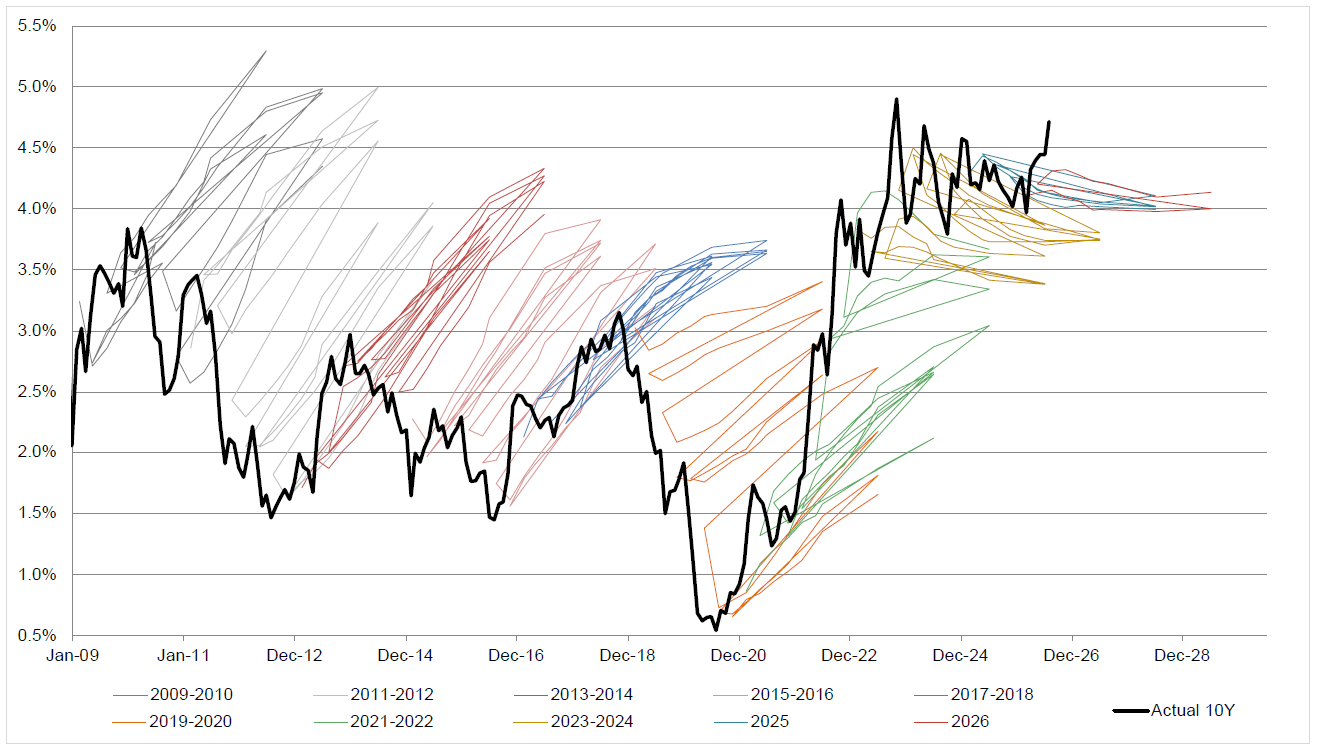
Source: FactSet, Philadelphia Fed Survey of Professional Forecasters, SaratogaRIM. Black line = actual (FactSet, month-end). Colored lines = SPF consensus forecast paths, one strand per quarterly survey vintage, colored by era (Philadelphia Fed Survey of Professional Forecasters; TBOND mean). Quarterly leg spliced with annual projections; full method and caveats available upon request. See Disclosures.
That recalibration extended well beyond interest rate forecasts. Businesses, governments, and investors increasingly anchored their decisions to a new conception of what constituted a normal cost of capital. Companies refinanced debt at increasingly favorable rates. Private equity sponsors increased leverage. Investors stretched for yield. Long-duration assets rose in value as discount rates declined. Governments found that large deficits could be financed at remarkably low cost. Asset prices came to reflect the assumption that capital would remain abundant and inexpensive essentially indefinitely.
The pandemic initially reinforced those conditions. The Federal Reserve returned rates to zero, financial markets received extraordinary support, and fiscal policy injected enormous amounts of money into the economy.
Yet the pandemic also marked an inflection point.
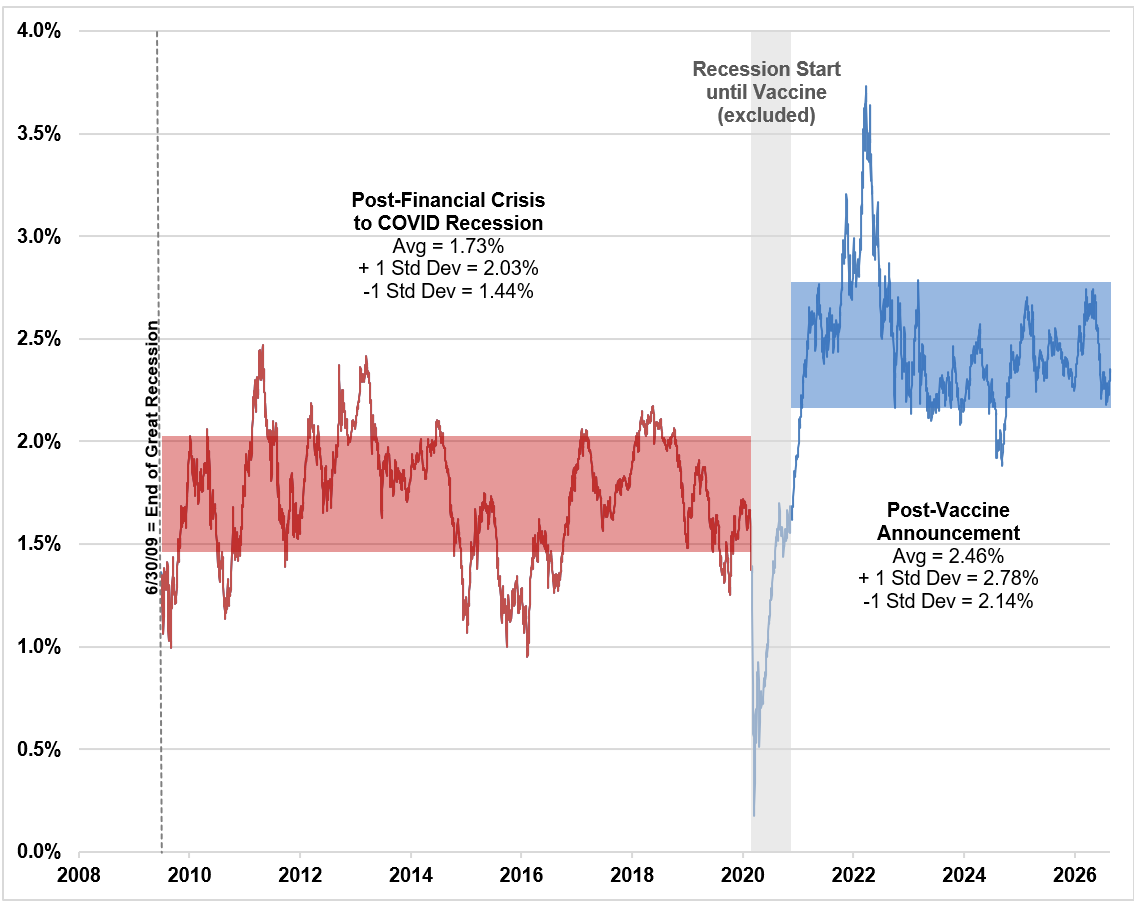
Supply chains were disrupted. Labor markets changed. Government spending surged. Household balance sheets were injected with free money. Demand recovered faster than supply. Inflation, which had been subdued for decades, spiked to its highest point since the 1970s. Although it subsequently declined from its peak, it has settled into a materially higher range. As the chart below shows, the inflation regime has changed.
Figure 6: 5-Year TIPS Inflation Breakeven Rate, Before and After COVID
The Shift to a Higher Inflation Regime
Source: Bloomberg, Bianco Research, SaratogaRIM. See Disclosures.
The Federal Reserve responded by raising policy rates. Interest rates since then have commonly been described as high. That perception is based entirely on the fact that the period that preceded it was a historically low interest rate anomaly.
Rates rose dramatically from the near-zero levels that followed the Global Financial Crisis and the pandemic. But direction and level are not the same thing. The short end of the yield curve has largely normalized after a highly abnormal period. At the long end, yields have also risen, but the term premium remains below the levels that were commonly observed as normal before the Global Financial Crisis.
The more accurate description isn’t that interest rates have become historically high. It’s that the cost of capital is normalizing unevenly after an extended period in which virtually all forms of capital were priced unusually cheaply.
For much of the past two decades, investors became accustomed to viewing inflation as primarily a cyclical phenomenon – one that could largely be managed through monetary policy. We increasingly view today's inflationary pressures as structural. Cyclical forces eventually fade. Structural forces can persist for decades.
We continue to believe the environment ahead is likely to differ meaningfully from the one investors became accustomed to following the Global Financial Crisis through the pandemic. Rather than returning to the persistently low and remarkably stable inflation environment that characterized much of the prior two decades, we expect inflation to average closer to 3% to 3½% over time, with greater volatility around that central tendency.
Our view is not based on the business cycle. It reflects several longer-term structural forces that appear likely to persist for years to come, including the powerful combination of deglobalization, demographic change, the unprecedented buildout of AI data center infrastructure, rising defense spending, and persistently high and growing fiscal deficits. Each of these forces increases demand for capital or constrains supply in ways that place upward pressure on inflation and interest rates.
We could certainly be wrong. But if these structural forces prove more durable than markets expect, both the average level and the volatility of inflation – and therefore the cost of capital – may remain materially higher than investors have become accustomed to over the decades following the Global Financial Crisis.
The consequences would extend well beyond inflation itself. The cost of capital influences virtually every important financial decision: which projects are pursued, how businesses are financed, and how investors value future cash flows. A sustained change in its level or volatility would therefore have important implications for capital allocation, corporate profitability, and the valuation of financial assets throughout the capital markets.
It’s important to understand that this ongoing normalization is occurring just as the demand for capital is surging. At the same time, one of the forces that helped make capital so abundant during the 40-year bond bull market has flipped into reverse. For decades, the baby-boom generation accumulated savings for retirement. As the boomers move further into retirement and draw down those savings, what was once a demographic tailwind is becoming a headwind.
Government deficits have become exceptionally large even in the absence of recession. Treasury issuance is increasing accordingly. The energy grid is requiring substantial investment, increasingly driven by the enormous power requirements of AI infrastructure. Manufacturing capacity is being reshored or duplicated as businesses respond to geopolitical risk. Defense spending is rising around the world. Existing corporate debt must be refinanced and infrastructure damaged by age, weather, and underinvestment must be replaced.
To these demands we must now add artificial intelligence. The companies participating in this buildout require semiconductors, servers, networking equipment, land, power generation, transmission capacity, cooling systems, construction labor, engineering expertise, and data centers on a previously unimaginable scale. All of this requires massive amounts of capital.
At first, much of the spending was financed internally by companies with extraordinary profitability and enormous cash balances. Increasingly, however, the scale of the commitments is pushing even some of the world’s strongest companies toward outside financing. According to Bank of America Global Research, the largest hyperscalers have already raised more than $300 billion from the bond market in 2026, more than twice the $136 billion they raised in all of 2025. The bond market, private credit, infrastructure funds, project-finance vehicles, joint ventures, leasing structures, and insurance-backed arrangements are all becoming part of the AI capital stack.
This is where the credit lens adds something that the technology narrative alone cannot. The technological question asks what artificial intelligence may ultimately accomplish. The microeconomic question asks how competition will determine who captures the value created. The financial statement analysis question asks when and how these investments will be reflected in reported financial results. The credit question asks who will supply the capital, on what terms, and at what price.
These are not separate stories. They are different perspectives on the same capital cycle.
In When Monopolies Converge, we examined how formerly distinct technology businesses are increasingly competing for the same customers. Offensive investments by one company become defensive necessities for another. Each may be acting rationally, even if the aggregate result may eventually lead to excessive investment, declining prices, and lower returns on capital.
In Understanding Capital Investment Cycles, we examined how the revenues generated by a capital boom appear quickly in the financial statements of suppliers, while depreciation, interest, maintenance, and replacement costs emerge more gradually for the companies making the investments.
Credit analysis adds another layer. The capital used to finance those investments has its own cost, and that cost can change long before the associated assets have produced their expected returns. This relationship is fundamental. An investment creates value only if the returns ultimately generated exceed the cost of the capital required to finance it.
Yet when investments extend years into the future, the ultimate cost of financing them is often unknown when those commitments are made. Financing may need to be renewed, additional capital may be required, interest rates may change, and credit spreads may widen long before the project begins producing its expected returns. Whether those investments create value will depend not only on the returns they eventually generate, but also on the cost of the capital ultimately required to finance them.
Financial statement analysis reveals the same underlying relationship through the DuPont framework. Leverage can enhance returns to shareholders when a business earns more on its assets than it pays for debt. When the cost of debt exceeds the return generated by those assets, the same leverage works in reverse.
What matters isn’t merely whether an investment produces revenue or accounting profit. What matters is whether it earns an adequate return relative to the capital committed and the risk assumed.
This relationship becomes more important as capital intensity rises. A software business requiring modest incremental investment can make mistakes without necessarily threatening its financial structure. A company committing hundreds of billions of dollars to long-lived physical infrastructure has less room for error. The projects must generate sufficient utilization, pricing, and cash flow to cover depreciation, operating costs, maintenance, and financing over very long timeframes.
Rapid technological change adds another complication. Some lenders financing AI chips are reportedly seeking repayment before the underlying leases expire because newer generations of chips may rapidly reduce the economic value of the equipment serving as collateral. The physical asset may be long-lived even when its economic usefulness is not.
If the cost of capital rises while expected project returns remain unchanged, fewer investments create value. If competitive pressure simultaneously reduces future margins, the hurdle becomes even higher.
The financial world around us therefore presents a striking contrast. On one side, the demand for capital is expanding rapidly. Governments are borrowing heavily. AI infrastructure requirements are exploding. Energy, defense, manufacturing, and refinancing needs are all competing for the same pool of savings.
On the other side, much of the credit market continues to offer investors relatively modest compensation. Spreads remain tight across large parts of investment-grade and high-yield credit. The long-term Treasury term premium, while rising, still remains below the pre-GFC norm. Equity valuations remain historically elevated.
None of this proves that markets are wrong. Strong corporate balance sheets, healthy nominal growth, abundant liquidity, continued access to financing, investor demand, and confidence in future productivity may justify some of today’s pricing.
The credit lens nevertheless helps us to see the tension. The quantity of capital being demanded is surging. The uncertainty surrounding inflation, fiscal policy, geopolitics, technology, and future returns is increasing. Yet the compensation available for bearing many of those risks remains remarkably low.
Beneath the surface of the credit market, investors are beginning to discriminate more carefully among borrowers. Broad investment-grade spreads remain historically tight, but significant dispersion is emerging within individual rating categories. Spreads have widened materially among the weakest borrowers, even as stronger credits continue to enjoy relatively favorable financing conditions, while the enormous volume of hyperscaler issuance is itself beginning to affect relative pricing across the market. Loan investors are starting to demand stronger covenants, more amortization, tighter collateral protection, and better documentation. Credit-default-swap markets are also increasingly distinguishing among the likely winners and losers of the AI buildout.
These developments don’t yet constitute anything remotely resembling broad financial stress. But they may represent something more subtle: the beginning of discrimination. And just perhaps, an early warning signal that investors are becoming less willing to accept the unusually modest compensation on offer for bearing risk.
During periods of abundant liquidity, capital markets often treat borrowers as though differences in balance sheet strength don’t matter very much. When conditions change, those differences reassert themselves. Companies with strong cash flows, modest leverage, and financing flexibility have optionality. Companies dependent on continual refinancing discover that the cost and availability of capital can change their strategic options very quickly.
This is why we have always considered financing risk one of the three primary sources of permanent capital loss, alongside business-model risk and valuation risk. Business-model risk asks whether the economics of the company will endure. Valuation risk asks whether the price paid already assumes more than the business can deliver. Financing risk asks whether the capital structure can survive long enough under stress for the underlying economics to even matter.
A great business can be impaired by excessive leverage. A promising investment can fail because financing disappears before the opportunity is realized. A company may possess valuable assets and still be forced to sell them at the wrong time because contractual obligations leave management with no alternative.
The order of claims matters most when things don’t go according to plan. When times are good, the distinction between debt and equity can seem almost academic. Interest payments are made easily, principal is refinanced, and shareholders participate in growth. During periods of stress, the capital structure becomes decisive. Contractual claims get paid first. Residual claims absorb anything that’s left.
This is also why liquidity must be distinguished from solvency. A company may own assets whose long-term value exceeds its liabilities and still fail if it cannot meet obligations when they come due. Conversely, a company with substantial cash may remain liquid for some time even while its business model steadily deteriorates. Credit analysis examines both questions because time is part of the obligation.
The contractual nature of credit imposes discipline. Debt matures. Interest must be paid. Covenants may be tested. Collateral may be pledged. Ratings can change. Lenders can refuse to refinance. Equity can wait; credit often can’t.
This discipline can make credit markets valuable sources of information. Bond yields, credit spreads, loan prices, ratings actions, and credit-default swaps may begin reflecting changes before those changes become visible in reported earnings. Even though we’re primarily equity investors, we take all of these factors into consideration.
As we discussed in Understanding Capital Investment Cycles, financial markets don’t wait for the second accounting clock to catch up. Credit markets may begin pricing financing pressure while income statements still reflect the profitability of an earlier business model.
That doesn’t mean bond investors are always right or that credit markets invariably lead equities. Credit markets are also influenced by liquidity, regulation, institutional constraints, technical flows, and human behavior. Prices contain information, but they are not the same thing as information. They still require interpretation.
That question – how financial markets incorporate information, risk premiums, and required returns into asset prices – belongs to the next lens in this series. For now, the more important lesson is that capital has a cost.
That cost begins with the compensation required to postpone consumption and give up flexibility. It rises with time, uncertainty, illiquidity, contractual weakness, and the possibility of default. It changes as the supply of savings and demand for financing change. It influences which projects get built, which companies can compete, which business models remain viable, and ultimately which capital structures survive.
The cost of capital doesn’t just determine what businesses are worth. It helps determine which businesses survive.
For much of the period following the Global Financial Crisis, unusually inexpensive capital has influenced nearly every part of the financial system. It has encouraged borrowing, inflated asset prices, reduced financing costs, and led governments, businesses, and investors to make decisions under the assumption that capital would remain cheap and plentiful forever.
That world has already changed.
The short end of the yield curve has largely normalized. Adjustment at the long end has been more gradual. Government financing requirements are expanding at an unsustainable pace. The AI infrastructure buildout is absorbing capital on a historic scale. Lenders are beginning to distinguish more carefully among borrowers. The price and terms of financing are starting to become important again.
None of this can tell us what happens next. Credit analysis can’t predict the future any more than behavioral finance, microeconomics, or financial statement analysis can. Its value lies elsewhere. It reveals obligations, dependencies, and feedback loops that other perspectives may not pick up on. It reminds us that growth requires financing, that leverage can magnify both success and failure, and that capital remains available only so long as someone is willing to provide it on acceptable terms.
Having explored why capital has a cost, the next question is whether markets have priced that cost correctly.
Editor’s Note
This essay is part of our ongoing Latticework Series, which examines today’s investment environment through the lenses of multiple disciplines. Previous essays explored behavioral finance, neuroscience, microeconomics, and financial statement analysis. This essay approaches the same broad questions through the lens of credit analysis, focusing on how the cost and availability of capital influence businesses, markets, and investment outcomes.
Complex investment problems rarely yield to a single discipline. Our objective is not to replace one framework with another, but to build a broader latticework of mental models in which each discipline contributes insights that the others cannot.
The next essay in this series, Pricing the Unknowable, will examine these same questions through the lens of financial theory. It will explore how modern finance came to define and measure investment risk, whether those measures capture the uncertainties that matter most to long-term investors, and what it means to price a future that cannot be known with precision.