
Financial Theory and the Limits of Measurable Risk
By Kevin Tanner | Chairman | CEO | Chief Investment Officer
Every investment is a claim on the future.
Whether purchasing a share of stock, a bond, an apartment building, a family business, or a farm, investors exchange capital today for the expectation of receiving something of greater value tomorrow. That expectation may take the form of future cash flows, appreciation in value, or both. In every case, however, the investment decision depends upon one unavoidable reality: the future has not yet occurred.
This observation may seem almost trivial. But it lies at the heart of every financial market, every investment decision, and every valuation model ever developed.
If the future were known with certainty, investing would become a simple matter of math. Future cash flows could be forecast precisely, the appropriate price calculated, and uncertainty would disappear from financial markets altogether. But the future cannot be known because it has not yet been written. Businesses face evolving technologies, changing government policies, shifting consumer preferences, new competitors, recessions, wars, pandemics, and the consequences of management decisions both smart and dumb. Every investment is ultimately influenced by countless events that have yet to unfold.
The challenge for investors therefore isn’t just that the future is uncertain. It’s that the investments we make today have to be made despite that uncertainty. This simple observation gives rise to one of the most fundamental questions in finance: How much compensation should rational investors require to be willing to commit capital to an uncertain future?
For more than a century, economists, mathematicians, and financial scholars have attempted to answer that question. Their work has profoundly influenced modern investing, corporate finance, capital budgeting, asset allocation, and the functioning of global financial markets. Concepts such as present value, discount rates, the cost of capital, Modern Portfolio Theory, and the Capital Asset Pricing Model all represent attempts to understand the relationship between uncertainty and value.
Despite their many differences, these frameworks share a common starting point. Traditional financial theory teaches that bearing risk requires compensation. The greater the risk, the greater the expected return rational investors should demand before being willing to commit capital to an uncertain future.
That proposition should be self-evident. The hard part isn’t recognizing that uncertainty should require compensation; it’s determining how much compensation is enough. But before financial theory can answer that question mathematically, it must confront an even more basic one:
What exactly do we mean by risk?
The Required Return
Financial theory has long recognized that the value of any financial asset depends not just on the cash flows it is expected to generate, but also upon the uncertainty surrounding those cash flows. This connection appears in different forms throughout the financial literature. It underlies discount rates, the cost of capital, bond yields, credit spreads, equity risk premiums, and virtually every major asset-pricing model developed over the past century.
The details differ from one theory to another, but the central idea remains remarkably consistent. Investors should willingly bear incremental uncertainty only because they expect to be compensated for doing so.
To understand why uncertainty should require compensation, it helps to begin with the components of an investor’s required return. At its core, the framework is surprisingly simple. Investors should require a return sufficient to compensate them for two things.
First, they must be compensated for postponing consumption. A dollar received ten years from now is worth less than a dollar received today, even if the future were perfectly certain. Time itself has value. Second, investors should require additional compensation for bearing uncertainty. Receiving their capital back with the passage of time is not enough; they must also be compensated for the possibility that future outcomes prove less favorable than expected. Together, these two components form the required return investors should logically demand before committing capital.
The first component is often represented by the risk-free rate. The second consists of one or more risk premiums representing the additional compensation investors require for bearing incremental uncertainty. Although financial theory has developed many different models for estimating these premiums, the underlying logic remains unchanged. The greater the uncertainty, the greater the compensation rational investors should require. These simple intuitions lie at the heart of the analysis of risk and return.
Financial theory has generally attempted to express these intuitions through measurable risk rather than uncertainty itself – a distinction that will become important shortly.
Investors purchasing long-term government bonds generally demand a term premium to compensate them for the additional uncertainty associated with committing capital over extended periods. Investors lending to corporations demand a credit spread above and beyond the return available on comparable government bonds to compensate for the incremental uncertainty associated with financial distress or default. Likewise, equity investors, who occupy the most junior position in a company’s capital structure and bear the residual uncertainty of ownership, should require an appropriate additional expected return above that available on risk-free securities. The measuring sticks differ, but each reflects the same basic intuition: greater uncertainty deserves greater compensation.
Behind every risk premium lies the same fundamental question: How much additional return is sufficient compensation for bearing uncertainty? Unfortunately, answering that question is considerably harder than asking it.
No one can directly observe how much compensation investors should require for bearing uncertainty. Unlike the coupon on a bond or the dividend paid by a stock, required returns cannot be measured directly. They exist only as expectations about an uncertain stream of future cash flows. Economists therefore can’t escape a simple fact: the appropriate price of uncertainty can’t be derived. It must be estimated.
For more than a century, financial economists have developed increasingly sophisticated models in their attempts to find a workaround. Although these models differ in their assumptions and mathematical structure, they share a common objective: estimating the additional return rational investors should require for committing capital to an uncertain future.
Economist Frank Knight, however, identified a giant fly in the ointment.
Risk and Uncertainty
In his 1921 book Risk, Uncertainty and Profit, Knight argued that economists often treated two fundamentally different concepts as though they were interchangeable. More than a century later, much of financial theory still seems to do exactly that.
Risk describes situations in which future outcomes are uncertain, but their probabilities can be estimated. Games of chance provide the simplest examples. We don’t know which number will appear on the next roll of a fair die, but we do know that each outcome has a one-in-six probability. Insurance companies similarly can’t predict which individual homeowner will experience a fire next year, but across millions of policies they can estimate expected losses with remarkable accuracy. The future remains uncertain, but the probabilities associated with its possible outcomes can be reasonably measured.
Now imagine something different. Suppose we reach into an opaque jar of marbles without knowing how many marbles it contains, how many are red, blue, or green, or whether it contains colors we haven’t even considered. We might draw conclusions based on the few marbles we have already drawn, but we still wouldn’t know whether such a limited sample accurately represented what remained inside the jar. We could assign probabilities to the color of the next marble, but those probabilities would ultimately depend on assumptions about something we simply can’t see.
Knight argued that many of the most important decisions in business and investing look much more like the problem posed by the opaque jar. Uncertainty describes situations in which the range of possible future outcomes and the probabilities associated with them cannot be known with confidence. No historical frequency tells us the probability that a revolutionary technology will reshape an industry, that a new competitor will permanently alter a company’s economics, or that a management team will allocate capital poorly over the next decade. Nor can the historical record tell us how geopolitical events, changing climate conditions, or other forces we cannot yet anticipate will reshape the economic environment in which those businesses operate. These outcomes are not just risky. They are genuinely uncertain.
Investing lives much closer to Knight’s world of uncertainty than to the world of measurable risk. Every investment ultimately depends upon assumptions about competition, innovation, regulation, management, financing, consumer behavior, and countless other forces that interact in ways no model can fully anticipate. Some uncertainties lend themselves to reasonable probability estimates. Others don’t. The further into the future we attempt to look, the wider the range of plausible outcomes becomes.
The figure below provides one way to visualize this concept. But it requires an important qualification. The curves are illustrative mental models, not measurable probability distributions. They represent the intuition that the further we look into the future, the wider the range of outcomes we should be prepared to contemplate. If those outcomes and their probabilities could be known, we would be much closer to operating in the realm of what Knight defined as measurable risk.
Figure 7: Illustrative Range of Possible Outcomes as the Investment Horizon Extends
The Range of Plausible Investment Outcomes Widens with Time.
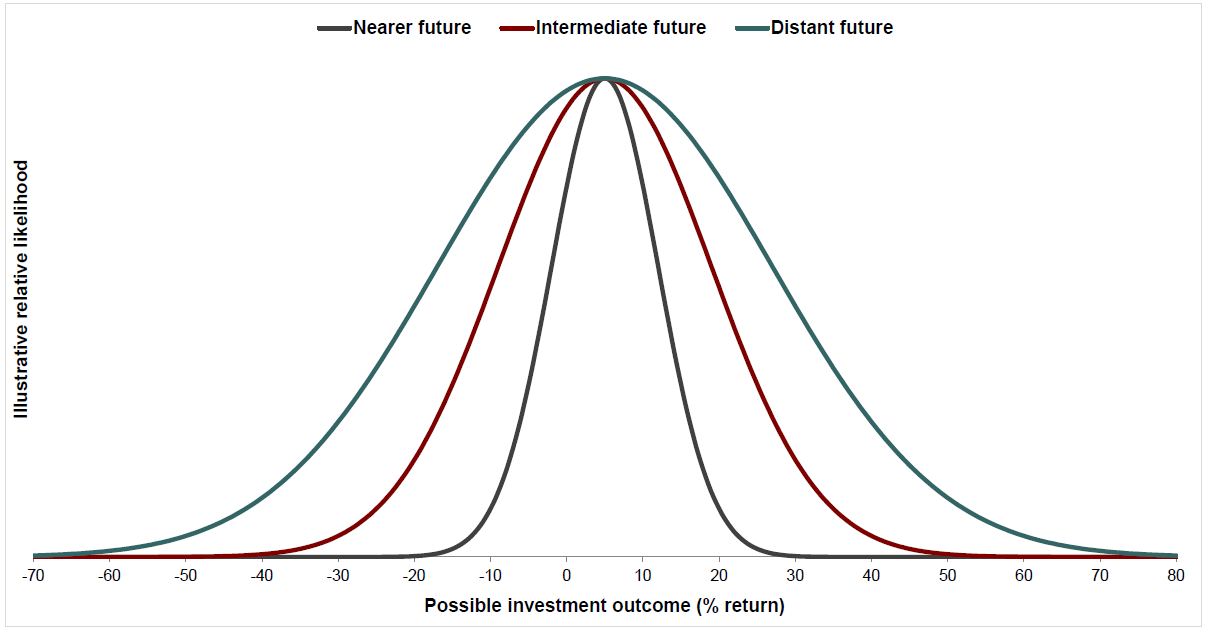
Source: SaratogaRIM. Nearer-term outcomes are shown as a narrower illustrative range; more distant outcomes span a wider range of plausible results. The widening reflects greater scope for interacting forces and unforeseen developments over time – not a claim that the true distribution is measurable. Vertical axis is conceptual; the peak of each curve is normalized to 100. See Disclosures.
Unfortunately, the real world is much more uncertain than this figure can possibly depict. Even a very wide probability distribution assumes that we have identified the range of all possible outcomes. A fat-tail event may be highly improbable, but it still exists somewhere within the distribution. Genuine uncertainty is different. The greatest investment surprises may not be outcomes to which we assigned too little probability, but possibilities we failed to imagine at all – outcomes that never made it into our distribution curve in the first place.
More than eighty years after Knight made his distinction, Secretary of Defense Donald Rumsfeld offered a more intuitive description of the same fundamental problem. During a 2002 Pentagon press briefing, he observed: “There are known knowns; there are things we know we know. We also know there are known unknowns; that is to say, we know there are some things we do not know. But there are also unknown unknowns, the ones we don’t know we don’t know. And if one looks throughout the history of our country and other free countries, it is the latter category that tend to be the difficult ones.”
With Rumsfeld’s words in mind, the preceding figure is best understood not as a model of uncertainty itself, but as a simple illustration of the limits of what we can know about an increasingly distant future.
Knight’s distinction raised a difficult challenge for financial economists. If genuine uncertainty cannot be measured directly, how can rational investors determine what compensation is sufficient before committing capital? Financial theory could not make uncertainty measurable, so instead it had to try to define risk in ways that were. The models that followed therefore approached the problem by identifying variables that they could measure and then trying to relate them to expected return. Within Modern Portfolio Theory (MPT), volatility became the measurable substitute for risk, quantified by variance or standard deviation.
A Round Peg in a Square Hole
Among the many models developed to quantify the relationship between risk and expected return, probably none has been more influential than the Capital Asset Pricing Model, commonly known as CAPM (pronounced “cap-M”). Developed during the 1960s by William Sharpe, John Lintner, Jan Mossin, and others, CAPM sought to answer a deceptively simple question: How much additional return should rational investors require for bearing risk?
But in order to answer that question mathematically, risk first had to be defined in a way that could be quantified. CAPM’s answer rested on one of the most consequential simplifications in modern finance: not all risk deserves compensation.
A rational investor can reduce the impact of many individual risks simply by diversifying their portfolio. The failure of a single product, a factory fire, the loss of a major customer, or the bankruptcy of one company may be devastating for an individual business, but their impact becomes increasingly diluted within a well-diversified portfolio. Since these risks can largely be diversified away, CAPM assumes that investors receive no additional expected return for bearing them. Under this framework, only the risk that cannot be diversified away deserves a risk premium.
This distinction between diversifiable and non-diversifiable risk became one of the defining pillars of MPT and an essential building block of CAPM. The risk that remains after diversification – often referred to as systematic or market risk – arises from broader forces that cannot be eliminated simply by owning more securities. Because investors cannot diversify it away, it becomes the only risk for which CAPM argues rational investors should demand additional compensation.
The practical challenge, however, remained. How should an individual security’s exposure to systematic risk be measured? CAPM’s answer was beta. The model is mathematically elegant, internally consistent, and has profoundly influenced academic finance, corporate decision making, investment management, and asset valuation for more than half a century.
Beta attempts to quantify systematic risk through the historical sensitivity of an individual security’s returns to movements in the overall market. A stock that has tended to move more than the market in the same direction is assigned a beta greater than one and, according to CAPM, should offer investors a higher expected return. A stock that has tended to move less than the market receives a beta below one and should offer a correspondingly lower expected return. The appeal of the model stems from its simplicity.
But viewed through Knight’s distinction between risk and uncertainty, that simplicity raises a more fundamental concern. Internal consistency alone cannot establish a model’s usefulness to long-term investors if its simplifying assumptions leave it unable to account for material risks that resist measurement. In making risk quantifiable, financial theory has substituted something measurable for the uncertainty investors actually face.
Warren Buffett once zeroed in on this issue when he observed that “volatility is far from synonymous with risk.” Knight’s distinction helps explain why: price volatility can be measured, while many of the uncertainties that determine an investment’s ultimate economic outcome cannot. If long-term investing is ultimately about owning a stream of future cash flows, then temporary fluctuations in quoted market prices should not, in themselves, be of primary concern to investors. Price volatility may create emotional discomfort and occasionally force short-term decisions, but it doesn’t derail internal compounding or necessarily destroy wealth.
Permanent impairment of capital does.
For long-term investors, therefore, the critical question has never been how much a stock’s price fluctuates from one month to the next. What matters are the circumstances that can permanently derail compounding. Viewed through this lens, permanent impairment of capital generally arises from three broad sources: business model risk, financing risk, and valuation risk.
This line of thought is more than semantic. If permanent impairment of capital – not short-term price volatility – is the outcome investors seek to avoid, then the relevant sources of risk are neither backward-looking nor purely statistical. They are forward-looking and economic, and many reside squarely in Knight’s world of uncertainty. The central question has never really been how much a stock’s price has fluctuated in the past, but rather what circumstances could permanently impair the future cash flows upon which its intrinsic value ultimately depends.
Business Model Risk
The first and perhaps most fundamental source of permanent impairment is deterioration in the economics of the underlying business.
Every business exists to provide a product or service for its customers or clients. When customers no longer value what it provides, its economic value inevitably declines regardless of how stable or volatile its share price may once have been. Competitive advantages can erode as consumer preferences change, new technologies emerge, better business models replace old ones, and industries evolve.
History is littered with the skeletons of once-dominant businesses that suffered permanent impairment as their economic foundations deteriorated. Manufacturers of buggy whips disappeared as automobiles replaced horse-drawn transportation. Eastman Kodak failed to adapt to digital photography despite helping invent it. Blockbuster Video’s nationwide franchise became obsolete as consumers embraced streaming. Palm, BlackBerry, Nokia, Digital Equipment Corporation, Polaroid, Sears, and Yahoo each occupied commanding competitive positions before technological change, shifting consumer preferences, or more capable competitors permanently undermined the economics of their businesses.
Financing Risk
The second major source of permanent impairment is financing risk.
A sound business can often survive a recession, an unexpected competitive challenge, or a temporary decline in profitability. An unsound balance sheet often can’t. Excessive leverage can transform otherwise survivable business setbacks into existential threats by reducing financial flexibility, increasing fixed obligations, and leaving little margin for error when events fail to unfold as expected. Leverage doesn’t create uncertainty. It magnifies the consequences of being wrong.
History again provides no shortage of examples. In 2007, a private equity consortium acquired TXU, one of America’s largest electric utilities and a quintessential “widows and orphans” stock, in what was then the largest leveraged buyout in history. The transaction converted a stable utility into a highly leveraged bet on natural gas prices. When that bet failed, its successor, Energy Future Holdings, entered bankruptcy in 2014, wiping out the equity invested in the deal. PG&E has declared bankruptcy twice during my career when enormous liabilities overwhelmed its financial capacity. General Motors, one of the world’s most iconic industrial companies, entered bankruptcy after years of mounting debt and financial obligations overwhelmed the business during the financial crisis. Lehman Brothers survived for more than 150 years before its highly leveraged balance sheet left it unable to withstand a sudden loss of market confidence. American International Group (AIG), one of the world’s largest insurers, required an unprecedented government rescue when enormous derivatives exposures and resulting liquidity demands threatened its survival. More recently, Silicon Valley Bank and First Republic demonstrated how rapidly financial institutions can fail when leverage, duration mismatch, and concentrated funding leave little room for unexpected changes in interest rates or depositor behavior.
These companies operated in different industries and faced crises for different immediate reasons. In each case, leverage or other financial obligations left insufficient capacity to absorb the resulting shock. Setbacks that might otherwise have been survivable resulted in permanent impairment of capital.
Valuation Risk
The third major source of permanent impairment is valuation risk.
Unlike business model risk or financing risk, valuation risk can exist even when investors correctly identify an outstanding business. A wonderful company purchased at an excessive price can prove to be a disastrous investment. No business, regardless of its quality, can indefinitely justify an unlimited valuation. Sooner or later, price matters.
The Nifty Fifty provides an instructive example. During the early 1970s, investors became convinced that the so-called Nifty Fifty represented a collection of companies so exceptional that they could be purchased at virtually any price – valuation simply didn’t matter. Many of those businesses – including Coca-Cola, Johnson & Johnson, McDonald’s, and Walt Disney – ultimately proved to be extraordinary companies, and some eventually grew into their lofty valuations. Yet investors who purchased near the peak endured the brutal 1973–74 bear market, with many waiting more than a decade for their investments to recover on an inflation-adjusted basis despite the continued success of the underlying businesses.
The technology bubble produced an even more dramatic illustration. Cisco Systems became one of the defining companies of the Internet era and, for a time, the world’s most valuable company. In many respects, Cisco was the Nvidia of its generation – a dominant business benefiting from a transformational technological revolution. Yet investors who purchased Cisco near its peak in March 2000 waited roughly a quarter century simply to break even on a nominal basis, and they’re still waiting after adjusting for inflation.
The common thread running through these examples was not business failure or excessive leverage. It was the price investors chose to pay. The underlying businesses continued to generate substantial cash flows and, in many cases, even strengthened their competitive positions. Nevertheless, investors suffered years or even decades of disappointing returns and, in some cases, what was effectively a permanent impairment of capital in real terms because even extraordinary subsequent business performance couldn’t justify the expectations already baked into the prices they paid.
Taken together, these three sources of permanent impairment reveal the gulf between the economic uncertainty investors actually face and the statistical risk financial models attempt to measure. Businesses fail because their economics deteriorate. Shareholders are wiped out because balance sheets become unsustainable. Investors suffer disappointing returns because they pay too much. Not one of these outcomes is fundamentally a function of historical price volatility.
A defender of CAPM could reasonably reply that this is precisely the point. Many of these failures reflect company-specific risks that diversified investors can reduce and for which CAPM never promised compensation. That defense is valid within CAPM: the model is designed to explain expected returns associated with systematic risk. Beyond recognizing that diversification can reduce their impact, the model makes no attempt to account for company-specific uncertainties capable of permanently impairing capital.
Yet even on its own empirical terms, beta has struggled. Black, Jensen, and Scholes found the relationship between beta and average returns was substantially flatter than CAPM predicted: low-beta securities earned more, and high-beta securities earned less, than CAPM implied. Fama and French later found that beta explained little of the variation in average stock returns once size and book-to-market were considered.
Individual dimensions of risk can often be measured, but the broader uncertainties we actually face simply can’t be reduced to a single number. This is not to suggest that beta is without value. Beta measures precisely what it was designed to measure: the historical sensitivity of a security’s returns to movements in the broader market. But viewed through Knight’s distinction between risk and uncertainty, treating beta as a meaningful measure of the risk long-term investors actually face looks much more like a very sophisticated hand wave.
The historical betas of buggy whip manufacturers, Kodak, Blockbuster, Palm, BlackBerry, Nokia, Digital Equipment, Polaroid, Sears, Yahoo, Enron, PG&E, General Motors, Lehman Brothers, AIG, Silicon Valley Bank, First Republic, Cisco, or any of the Nifty Fifty provided investors with little meaningful insight into the uncertainties that ultimately determined their investment fates. Those uncertainties arose from deteriorating business economics, fraudulent reporting, excessive leverage, or simply from paying too much – not from the historical sensitivity of their returns to movements in the broader market.
The risk of permanent loss of capital is forward-looking and economic, not backward-looking and statistical.
From Measurement to Judgment
Statistician George Box famously observed that “all models are wrong, but some are useful.” Every model necessarily simplifies reality. The relevant question is whether that simplification remains useful for the problem we are trying to solve.
For long-term investors, that is where beta runs into trouble. Although a security’s historical sensitivity to market movements can be measured precisely, that measurement may reveal little about the forward-looking business, financing, and valuation risks capable of permanently impairing capital.
Business model risk, financing risk, and valuation risk do not lend themselves to a common unit of measurement. We can calculate leverage ratios, interest coverage, valuation multiples, historical returns on invested capital, market shares, and countless other useful statistics. We can examine competitive structures, management decisions, technological change, customer behavior, capital allocation, and the assumptions embedded in market prices. Each can tell us something important. But none can tell us everything we need to know.
More importantly, neither measurement nor analysis eliminates the Knightian problem. A company’s current balance sheet may be known with considerable precision; the stresses it will encounter over the next decade cannot be. We can observe a company’s present competitive position; we cannot assign a reliable probability to the possibility that a technology not yet invented will undermine it. We can estimate intrinsic value under different assumptions; we cannot know in advance which assumptions the future will validate.
This is precisely why the distinction between risk and uncertainty matters so much to long-term investors. If the outcomes that can permanently impair capital cannot be completely specified in advance, much less assigned reliable probabilities, no amount of mathematical sophistication can make genuine uncertainty measurable simply by assigning numbers to it.
At the end of the day, we are left with something both less precise and much more demanding: judgment. Knight’s insight extended beyond the difference between measurable risk and genuine uncertainty. He also recognized that people do not act directly on the facts they observe. “We perceive the world before we react to it,” he wrote, “and we react not to what we perceive, but always to what we infer.” Put more simply, we act on the stories we construct from the facts, not the facts themselves. That insight is especially important for investors. Financial statements, market prices, interest rates, competitive positions, and other observable facts provide evidence. But none tells us what a business will earn a decade from now or what it is worth today. To make an investment decision, we eventually have to use that evidence to form a judgment about a future we cannot observe. Measurement can’t eliminate judgment because judgment is what connects the facts we know to the future we don’t.
Judgment does not mean abandoning analysis. Quite the opposite. Analysis, however, should not be confused with precision. The less certain the future, the more important it becomes to conduct a thorough analysis of the business, its competitive position, its financing, the quality of its management and capital allocation, the assumptions embedded in its valuation, and the consequences if those assumptions prove wrong.
The purpose of analysis cannot be to eliminate uncertainty. Knight tells us why that is impossible. Its purpose must instead be to understand the sources and potential consequences of uncertainty well enough to make better decisions despite the limits of what can be known.
That is where the problem posed by financial theory becomes the problem confronted by security analysis.
Conclusion
Every investment remains a claim on an unknowable future. Technologies will evolve, businesses will succeed and fail, governments will rise and fall, wars will begin and end, and new competitors will emerge. The full range of possible outcomes can never be known in advance.
Traditional financial theory gave investors an elegant framework for thinking about risk. It taught us that risk should command a price and that rational investors should demand greater compensation as risk increases. Modern Portfolio Theory demonstrated the power of diversification, while CAPM attempted to identify the risk for which diversified investors should expect to be compensated and to quantify an individual security’s exposure to it through beta.
Knight’s distinction reminds us that the world we must confront is considerably messier. Much of what determines long-term investment outcomes cannot be reduced to measurable risk. The future is genuinely uncertain.
This is critical because the risk long-term investors ultimately care about is not synonymous with the volatility of quoted market prices. It’s the degree of exposure to permanent impairment of capital – the destruction of the economic value upon which future compounding depends.
History shows the many forms that impairment can take. Once-dominant businesses can lose their economic relevance. Excessive leverage can turn survivable setbacks into existential ones. Extraordinary businesses can become terrible investments when investors pay prices that require an equally extraordinary future merely to justify them. Beta tells us little about any of these possibilities.
The historical volatility of a security’s returns can be calculated with mathematical precision. The durability of a competitive advantage, the future decisions of management, the resilience of a balance sheet under circumstances we cannot anticipate, and the valuation that an unknowable stream of future cash flows can ultimately support all require judgment.
That does not make analysis futile. It makes the quality of the analysis – and the judgment applied to it – more important.
The central problem therefore changes. Instead of asking how we can reduce investment risk to a statistic, we must ask how we, as professional investors, should make decisions when the risks that matter most are forward-looking, economic, and often impossible to quantify with precision.
That question takes us beyond financial theory and into the next lens in our Latticework Series: Security Analysis.
Security analysis doesn’t render the future any more knowable. But it can provide a disciplined process for deciding which uncertainties we are willing to bear, which we are not, and how much cushion we should require for the possibility that our judgment proves wrong.
Editor’s Note
This essay is part of our ongoing Latticework Series, which examines the financial world around us today through the lenses of multiple disciplines. Previous essays explored behavioral finance, neuroscience, microeconomics, financial statement analysis, and credit analysis. This essay adds the lens of financial theory, examining how economists have attempted to quantify the relationship between risk and expected return – and whether the forms of measurable risk captured by those models adequately reflect the uncertainty that ultimately matters to long-term investors.
Frank Knight’s distinction between measurable risk and genuine uncertainty provides an important bridge between financial theory and the investment decisions made in the real world. Modern financial models can measure certain dimensions of risk with considerable precision, but the risks capable of permanently impairing capital are frequently forward-looking, economic, and impossible to reduce to a single statistic.
Complex investment problems rarely yield to a single discipline. Our objective is not to replace one framework with another, but to build a broader latticework of mental models in which each discipline contributes insights that the others cannot.
The previous essay examined how the cost and availability of capital influence businesses, markets, and investment outcomes. The next essay turns to Security Analysis and the role of judgment in an uncertain world. If the risks that matter cannot be completely measured or reliably assigned probabilities, security analysis asks how investors can nevertheless develop a disciplined process for evaluating businesses, financing, valuation, and the possibility of permanent capital impairment before committing capital.