
By Kevin Tanner | Chairman | CEO | Chief Investment Officer
2026 Q3 Letter to Investors
Three months ago, our Q2 Letter described a market increasingly shaped by artificial intelligence, momentum, extreme valuations, and blatantly speculative behavior. The capital markets were more than willing to feed that appetite. SpaceX had just completed the largest initial public offering in history and returned less than two weeks later for another $25 billion of debt financing. At the time, OpenAI and Anthropic were both preparing public offerings, Alphabet had announced an enormous new equity-capital program, and the world's largest technology companies were tapping debt and equity markets to finance an AI infrastructure buildout at unprecedented scale. The question I asked at the time was simple: Why is so much stock suddenly coming up for sale?
We were careful not to suggest that issuance itself could tell us when this market cycle would end. It can’t. But financial history contains a recurring pattern. When investors become increasingly eager to buy, companies, founders, venture capitalists, and other owners become increasingly willing to sell. Capital has a remarkable tendency to flow toward wherever the excitement is. Railroads, radio, telecommunications, the internet, and housing all experienced enormous capital-raising booms as investors competed to finance technologies or assets they believed would reshape the future. The innovation was real. So too, eventually, were the excesses.
Three months later, the supply of capital-seeking securities has not slowed. If anything, the financing machinery surrounding artificial intelligence has accelerated. Public equity, corporate bonds, private credit, project financing, joint ventures, leasing arrangements, and special-purpose vehicles are all being used to fund the buildout. Anthropic is now lining up what could become the largest initial public offering in history as soon as next month, reportedly targeting a valuation of as much as $2 trillion, potentially making SpaceX’s record remarkably short-lived.
Scale is only part of the story. Amazon is reportedly exploring moving roughly $8 billion of advanced Nvidia chips into a special-purpose vehicle financed in part by outside investors, then leasing back the chips. The forms in which capital is being raised are evolving at least as fast as the underlying economics. From multiple angles, today’s artificial-intelligence-driven investment boom is demanding an extraordinary amount of other people’s savings.
What has changed during the third quarter is the price of access to those savings.
For most of the period following the Global Financial Crisis, capital was extraordinarily inexpensive. Near-zero short-term rates, quantitative easing, and unusually low long-term Treasury yields reduced the cost of financing almost everything. They also reduced the opportunity cost of owning riskier assets. When safe bonds offered investors very little, the competition they presented to stocks, real estate, private equity and other long-duration assets was correspondingly limited.
That world is now clearly in the rearview mirror. The 10-year Treasury ended the quarter near 5.3%, while the 30-year briefly exceeded 5.6%. As we have discussed repeatedly over recent years, we don't view those yields as historically unusual. What was unusual was the extraordinarily low cost of capital that preceded them. The structural forces we have been discussing for several years – Deficits, Defense spending, Deglobalization, Demographics and Data center capital expenditure – are simultaneously increasing the demand for capital and constraining its supply. That does not mean rates must rise continuously. Cyclical forces will always matter. But it does suggest that the equilibrium around which rates will fluctuate going forward looks to be considerably higher than the one investors became accustomed to during the QE era.
The consequences are beginning to appear beneath the surface of financial markets. At the index level, they are easy to miss. The S&P 500 finished the quarter close to its record, supported by the enormous companies at the center of the AI trade. But underneath that capitalization-weighted index, the picture has become much less uniform. Unprofitable technology companies, weak-balance-sheet businesses, small-cap stocks and other interest-rate-sensitive areas have come under increasing pressure. In credit markets, the distinction is even clearer. Investment-grade spreads remain relatively calm, as do most higher-quality high-yield bonds. The weakest credits have behaved very differently. CCC spreads have widened dramatically while better-quality borrowers have been far less affected.
This isn't an “everything is falling apart” story. The weakest part of high yield represents less than 10% of that market. It is a story about differentiation. Capital remains readily available to the strongest borrowers and to businesses associated with the most compelling investment narrative of the moment. Yet it is becoming more expensive, and the market is beginning to charge very different prices depending upon who is asking for it. Weak balance sheets become more consequential when refinancing is expensive. Current profitability becomes more valuable when investors can earn meaningful returns without waiting years for promised cash flows to materialize. Price matters more as risk-free alternatives move further away from zero.
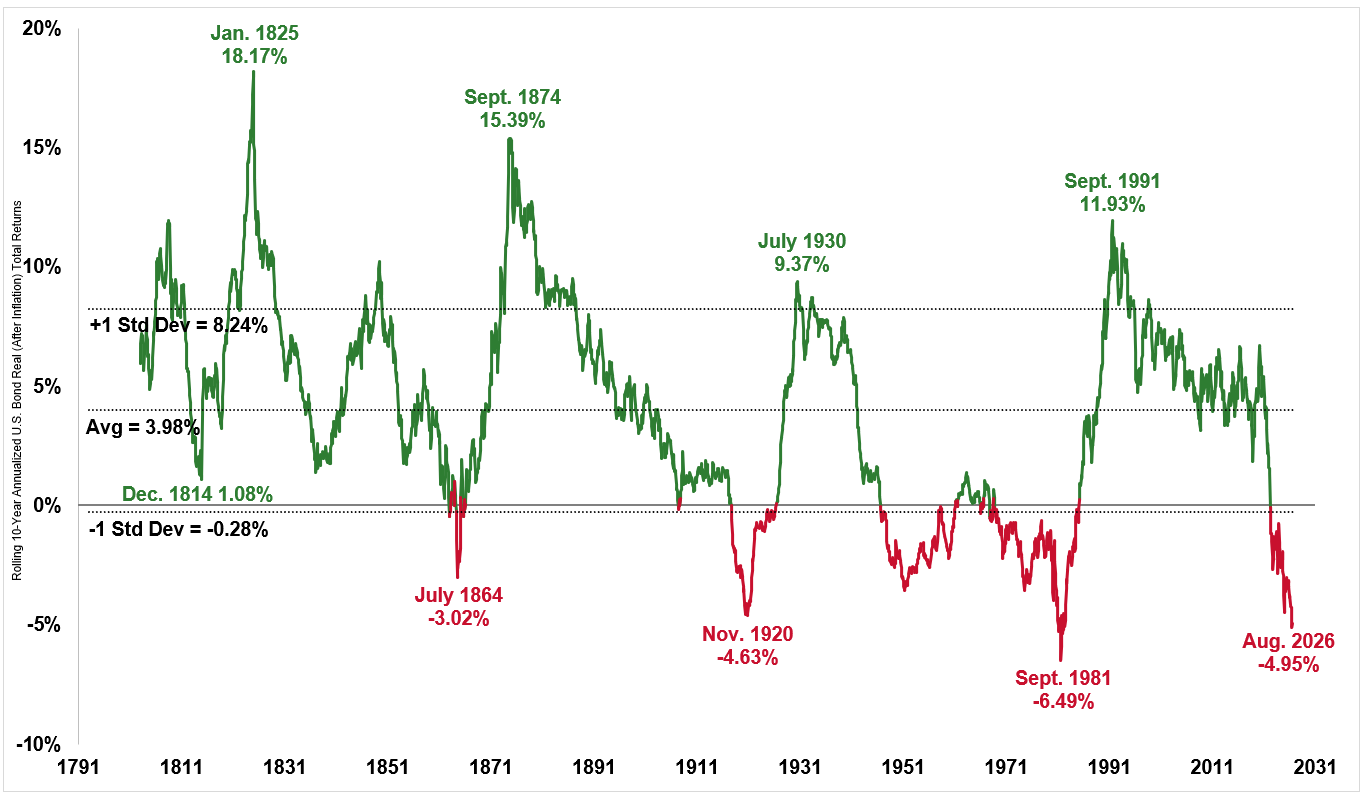
We believe that last point may prove especially important. For most of the past decade, investors have been rewarded handsomely for owning stocks and punished severely for owning bonds. Over the ten years ending this summer, U.S. stocks generated an annualized real return of approximately 10.2%, far above their long-term average of 6.3%. Over the same timeframe, U.S. bonds actually suffered an annualized real loss of approximately 5%. In nominal terms, the most recent ten-year bond return was the worst ever in a historical series extending back to 1793. It would be difficult to design a better setup for recency bias to take hold.
After a decade in which stocks worked and bonds didn't, it is natural for investors to become increasingly confident in the former and increasingly skeptical of the latter. Yet the very market movements responsible for those historical returns have changed the prospective economics of both asset classes.
Rising stock prices have pushed equity valuations toward extraordinarily rare historical levels. Falling bond prices have pushed bond yields to levels that increasingly offer meaningful prospective returns. In other words, the extraordinary returns from stocks are part of the reason their prospective returns have become less attractive, while the extraordinary losses from bonds are part of the reason that their risk-reward characteristics are beginning to look more attractive.
Today, Robert Shiller's cyclically adjusted price-to-earnings ratio sits above 40. Across a monthly history beginning in 1881, valuations higher than today's have occurred almost exclusively around the peak of the dot-com boom. Starting valuation has never been particularly useful for predicting what stocks will do next month or next year. But it has been considerably more informative about the range of returns investors subsequently earned over much longer periods. Our regression of starting CAPE against subsequent 10-year real returns currently implies a negative real return. That isn't a forecast. The future has no obligation to conform to a historical regression. But nobody should ignore what historical relationships suggest about today's pricing in terms of potential future returns.
Interest rates have returned to much more normal levels. From here, rates no longer need to fall for bonds to become more competitive. Our structural argument is quite the opposite. Rates may still have considerable normalization ahead of them. But the mathematics of fixed income change as starting yields rise. At a 2% yield, there is very little income available to absorb the price decline caused by higher rates. At 5% or 6%, there is considerably more. Each increase in yield improves the prospective income available to the next buyer and creates a larger cushion against additional rate increases.
The contrast with equities is striking. As rates have risen, the prospective economics of bonds have gradually improved. At the same time, higher risk-free rates have increased the discount rates applied to equity valuations and created an increasingly competitive alternative with no business risk attached. The same math that makes bonds more competitive can render exceptionally expensive stocks more difficult to justify.
There is nothing magical about 5% on the 10-year Treasury or 6% on the 30-year. But at some point a risk-free yield stops being merely an input in a valuation model and becomes a genuine competitor for capital. We may be very close to entering that realm now.
The behavioral challenge is that investors naturally look backward when forming expectations about what lies ahead. The asset that has treated us well feels safer. The asset that has caused pain feels more dangerous. Confidence rises after favorable outcomes and falls after unfavorable ones, even when price movements that produced those outcomes render prospective returns less attractive after gains and more attractive after losses.
The bond market offers an extraordinary historical example. By September 1981, bonds had produced a real annualized loss of roughly 6.5% over the preceding decade. Few investors could have felt good about owning them. Yet the rise in yields responsible for those terrible trailing returns had simultaneously transformed their prospective economics, resulting in one of the greatest buying opportunities of all time. What followed was a bull market in bonds that would last roughly four decades.
Figure 16: Rolling 10-Year Annualized U.S. Bond Real (After Inflation) Total Returns Since 1793
Source: Edward F. McQuarrie, Santa Clara University, Bianco Research, SaratogaRIM. See Disclosures.
The circumstances today are very different from 1981. Then, terrible trailing returns reflected interest rates rising toward their all-time peak. Today’s terrible trailing 10-year returns owe much more to the historically anomalous low yields from which they started. But the lesson is the same: the returns investors have recently experienced and the prospective economics available today are two different things.
The same discipline applies to equities. A decade of extraordinary returns suggests very little about what the next decade will deliver. Starting valuation appears to tell us considerably more. A CAPE ratio above 40 can’t predict when the market will turn or what stocks will do over the next year, but nearly a century and a half of market history demonstrates that the price investors pay has mattered enormously to the long-term returns they subsequently receive. Today’s valuation can’t tell us what will happen next. But it does suggest that investors should expect lower long-term returns when they begin from exceptionally high valuations. And at today’s prices, investors are paying an extraordinary amount for an unusually uncertain future. The price we are willing to pay matters.
That brings us back to the project we began in last quarter's Letter. Inspired by Charlie Munger's concept of a latticework of mental models, over the past quarter we have examined the same financial environment through a succession of different analytical lenses.
Behavioral finance helped us understand why investors repeatedly extrapolate favorable experience. Neuroscience explored why uncertain rewards can exert such a powerful pull on human decision-making. Microeconomics asked who ultimately captures the value created when powerful businesses converge on the same opportunity. Financial statement analysis examined timing differences and how the benefits of a capital boom can appear long before its costs. Credit analysis shifted our attention toward who is financing the buildout, on what terms, and with what consequences. Financial theory forced us to confront the distinction between measurable risk and genuine uncertainty. Security analysis asked how we can build resilience around what we cannot know. And finally, Wisdom and Madness returned to the market itself and the human judgments that determine the price at which uncertainty is offered to us.
Each discipline has added something important. None can tell us what happens next. But that’s not a shortcoming of the exercise – in many ways, it is its most important conclusion.
We can't know whether Anthropic's upcoming IPO will be greeted with the enthusiasm that initially surrounded SpaceX or with skepticism. We don't know whether the deterioration now visible in the weakest credits will remain contained or spread toward stronger borrowers and beyond. We don't know whether Treasury yields continue to rise at their current pace, pause, or temporarily reverse. And despite everything we have learned about artificial intelligence over the past several months, we still can't know which businesses will ultimately capture the economics of this extraordinary technology or which of today's prices already assume too much of that success.
Investing has never required certainty. It requires judgment under uncertainty. And when we are investing other people’s money, that judgment carries additional weight.
The final essay in our Latticework Series, which follows this Letter, is titled Stewardship: First Principles for Investing Under Great Uncertainty. It begins where all of the preceding essays ultimately lead. If the future cannot be known, if markets can be both wise and mad, if even thorough analysis cannot eliminate the possibility that we will be wrong, what principles should govern the decisions we make with capital entrusted to our care?
Our answer begins with two ideas that have anchored our investment philosophy for decades: Quality protects us from owning businesses that break. Value protects us from overpaying. Neither eliminates uncertainty. But together, they protect us from needing to attempt an impossible task: predicting the future with precision.
Underlying both is an even more fundamental principle: the capital is not ours. And that is why our Latticework Series culminates with Stewardship.
Stewardship
First Principles for Investing Under Great Uncertainty
Benjamin Graham is widely regarded as the father of modern security analysis. With the publication of Security Analysis in 1934, coauthored with David Dodd, Graham sought to elevate investing from an activity often dominated by speculation, rumor, and intuition into a discipline grounded in rigorous fundamental analysis. His objective wasn’t to eliminate speculation, of course. No framework could. What he did was give investors an intellectually coherent alternative.
Financial history teaches that the lessons of disciplined investing are repeatedly learned – and repeatedly forgotten. Disciplined investing can never displace speculation. Narratives, technology, and opportunities are always changing. What doesn’t change is human nature. From time to time, every generation is tempted to believe that prudence has become obsolete. Eventually, every generation rediscovers that it never does.
This recurring cycle helps explain why Graham’s ideas remain so relevant nearly a century later. Among them, perhaps none has proven more relevant than his concise definition of investing: “An investment operation is one which, upon thorough analysis, promises safety of principal and an adequate return. Operations not meeting these requirements are speculative.”
At first glance, Graham’s definition appears deceptively simple. But it contains an entire philosophy of investing compressed into a single sentence. Graham chose his words carefully. An investment operation requires thorough analysis, safety of principal, and an adequate return. These are not independent objectives. They are complementary components, each reinforcing the others. Together, they establish a remarkably solid framework for investing under uncertainty.
In a very real sense, the purpose of this Latticework Series has been to explore what Graham’s requirements demand in the world around us today. The disciplines examined were not selected because they supported any particular view on artificial intelligence, the economy, or even the markets. They were selected because each allows us to view uncertainty from a different angle and through a different lens. Taken together, they provide a more complete understanding of the forces that shape business economics, market prices, investment outcomes, and the risks investors must confront. The conclusions reached in these essays are not conclusions I set out to prove. They are simply where the evidence from those disciplines collectively led.
A Latticework of First Principles
Charlie Munger often emphasized that complex problems rarely yield to a single intellectual model. Reality does not organize itself neatly into academic departments, and neither should serious investment analysis. Businesses operate simultaneously within competitive, financial, accounting, psychological, technological, political, and social systems. Understanding only one dimension may inform an opinion, but it can also produce dangerous overconfidence.
Each discipline in this series therefore contributed something different, revealing aspects of businesses, markets, and investment risk that other disciplines might miss. Collectively, these perspectives enable a more complete framework for thinking about the challenges of investing in the extremely uncertain world around us today.
Behavioral finance and neuroscience reminded us that markets aren’t simply mathematical systems. They are human systems. Market prices emerge from the collective decisions of millions of imperfect people, each bringing their own incentives, emotions, and cognitive biases. Consequently, market prices and underlying intrinsic value are separate and distinct. And at times, they can and do diverge dramatically.
Understanding this distinction lies at the heart of investing. If price and value were always identical, security analysis would serve little purpose. There would be nothing to analyze beyond the price already displayed on the screen. But markets are auctions, not omniscient calculating machines. Prices contain information, but they also reflect fear, greed, extrapolation, career risk, institutional constraints, forced buying and selling, and the powerful influence of prevailing narratives. Markets can process enormous amounts of information with remarkable efficiency while still reaching conclusions that later prove profoundly wrong.
Microeconomics reminds us that no competitive advantage is permanent just because it exists today. Every business operates within a dynamic competitive ecosystem where technologies are evolving, competitors are adapting, customer preferences are changing, and economic incentives are continually reshaping the competitive landscape. Seeking businesses with durable competitive advantages – or economic moats – is therefore an essential part of our investment process. But moats don’t exist in isolation. Like fortifications throughout history, they must be continually strengthened, adapted, and defended if they are to remain effective. The long-term ability of a business to continue compounding intrinsic value depends not just on the strength of its moat today, but on management’s ability to preserve, extend, and adapt that moat as the competitive environment evolves.
This is especially important during periods of transformative innovation like today. Artificial intelligence will almost certainly create enormous value for society. But helping create that value doesn’t entitle a company to capture it, much less guarantee that whatever value it initially captures can be retained over time. Innovation may determine how much value is created, but competition has a very large say in determining who ultimately gets rewarded. We don't own economies or technologies in the abstract. We own businesses, and our returns will ultimately depend not on the magnitude of the innovation, but on the durability of the economics of the businesses we own.
Financial statement analysis reminds us that accounting is an indispensable language of business, but it is not the business itself. Financial statements can provide an extraordinarily rich representation of economic reality, yet they remain a representation. Every important business decision eventually leaves an economic footprint in the income statement, balance sheet, or statement of cash flows, but those effects may appear at different times and in different forms. Understanding what the numbers reveal – and what they don’t – is essential to understanding the economics of a business.
Reported earnings should therefore be the beginning of analysis rather than its conclusion. Accounting classifications, estimates, useful life assumptions, capitalized expenditures, changes in working capital, financing activities, and noncash gains or losses can all influence the story told by a headline number. The financial statements must therefore be read together, along with the notes that explain how the numbers were produced, to better understand the underlying economics of the business. Sometimes today's reported earnings are still describing yesterday's business model, while the balance sheet and cash flow statement are already revealing a business whose economics are changing in ways that won't become fully visible in the income statement until years down the road.
Credit analysis reminds us that even exceptional businesses can be permanently impaired by overly aggressive financing. Capital structure is not simply a financing decision; it’s an integral part of the quality of a business.
Financing decisions are made at a point in time. The economics of those decisions continue to evolve. Changes in interest rates, credit markets, or a company’s own creditworthiness can materially increase its cost of capital years after an original financing decision was made, altering the ultimate economics of investments undertaken under materially different cost-of-capital assumptions. At the same time, higher financing costs can fundamentally reduce a company’s future optionality by limiting the set of investment opportunities it can profitably pursue.
Leverage therefore does more than magnify outcomes. It can create obligations and dependencies that reduce financial flexibility, narrowing the range of future environments a business can successfully navigate when conditions unfold differently than expected. When conditions deteriorate, declining credit quality can itself become causal: borrowing costs rise, lender appetite contracts, financial flexibility declines, investment is curtailed, and competitive position can weaken. Sometimes an overly aggressive capital structure can take an otherwise healthy business down with it.
Financial theory reminds us that every valuation is ultimately an attempt to estimate an uncertain future. The intrinsic value of a business depends on the cash it is expected to generate over time and the return investors require for committing their hard-earned money to that uncertain future. The greater the uncertainty surrounding a business’s future cash flows, the higher the return investors should generally require to compensate them for bearing it.
In theory, markets continuously translate changing expectations about future cash flows, growth, profitability, inflation, interest rates, competition, and risk into prices through changes in expected cash flows and the discount rates investors apply to them. How accurately they do so is another question.
The mathematics are indispensable, but they cannot eliminate the judgment embedded within them. Unlike the contractual cash flows of most fixed-income securities, the future cash flows of a business cannot be observed directly. They must be estimated. Nor can the appropriate discount rate be observed. It also requires judgment. Small changes in either assumption can have enormous effects on the value assigned to long-duration assets, especially when much of the expected economic benefit lies far in the future.
Financial theory provides a rigorous framework for thinking about value, but it can’t entirely account for future uncertainty. Nassim Nicholas Taleb, whose work on Black Swan events challenged many conventional assumptions about risk and uncertainty, pushes the uncertainty problem one step further. It is not merely that we cannot know which outcome will occur. We may not even know the shape of the distribution from which future outcomes will be drawn. Conventional models often describe the world as though the range and frequency of possible events can be estimated from historical data. Financial history repeatedly reminds us otherwise.
The Panic of 1907, the crash of 1929, the upheaval of 1973 and 1974, the crash of 1987, the dot-com bust, the Global Financial Crisis, wars, pandemics, political ruptures, technological discontinuities, and countless other unforeseen events have repeatedly exposed the limits of prevailing assumptions. The details have always differed, but the lessons are remarkably consistent. Reality is not obligated to remain within the boundaries of our models – or even our imagination. The cost of being catastrophically wrong can therefore exceed not only what conventional models imply, but what most investors even think possible.
None of this means analysis is futile. It simply means that nothing is guaranteed in life and that analysis must be accompanied by humility. A sound investment philosophy cannot depend on an ability to forecast the next Black Swan. We cannot build an investment process around predicting the next surprise. That’s why ours has been designed with the objective of better withstanding the consequences when inevitable surprises do arrive.
An Unusually Uncertain Starting Point
The world is always uncertain. That alone doesn’t distinguish the present. What distinguishes the current environment is the number, scale, and interaction of the structural changes occurring at the same time.
Artificial intelligence will likely prove to be one of the most important technologies in history, yet the competitive, economic, accounting, financing, regulatory, and social consequences of its development remain profoundly uncertain. Companies are committing extraordinary amounts of capital to projects whose ultimate economics may not be known for many years. The assumptions made when those projects are approved may differ materially from the financing conditions, competitive landscape, regulatory structure, technological requirements, and customer demand ultimately experienced over their useful lives.
This uncertainty extends far beyond artificial intelligence. Geopolitical relationships are being reordered. Globalization is in retreat. Demographic pressures are intensifying. Defense spending is surging, and fiscal deficits have become impossible to ignore. Data center construction is creating enormous new demands for capital, power, equipment, and infrastructure. Together, these forces appear to be placing persistent upward pressure on inflation, interest rates, and the cost of capital. The postwar order that supported decades of expanding trade and prosperity is buckling.
Businesses and investors must commit capital today without knowing what kind of world that capital will have to navigate in the years to come.
Uncertainty by itself doesn’t necessarily make an investment unattractive. An uncertain investment can be compelling when the potential return remains attractive across a sufficiently wide range of possible outcomes. Conversely, an apparently stable investment can be exceptionally dangerous when its price assumes that little can go wrong. Risk concerns the possibility of permanent capital impairment. Uncertainty arises from our inability to know in advance the circumstances that might produce it. Confusing the two can lead investors to avoid attractive opportunities because they appear uncertain while embracing dangerous ones because recent experience has made them appear more predictable than they really are.
The more troubling feature of the current environment is therefore the combination of unusually broad uncertainty and the modest compensation prevailing prices appear to offer for bearing it. Equity valuations remain historically expensive by most measures and near historical extremes by some, even as geopolitical, technological, fiscal, competitive, and financing uncertainties have multiplied. Credit spreads likewise suggest that investors require relatively little compensation for assuming credit risk despite those same uncertainties. When investors demand less compensation for uncertainty, the margin for error inevitably becomes smaller.
None of this is a prediction that markets must decline, nor is it an argument for abandoning equity ownership. We have never viewed market timing as part of our mandate. The only thing I know for sure about the future is that I do not know for sure what is going to happen. But uncertainty and valuation must be considered together. When the range of possible outcomes is unusually wide and prevailing prices leave little room for error, the consequences of being wrong become unusually large. Investors can ignore that asymmetry, but they do so at their own risk.
From Graham, Buffett, and Munger to SaratogaRIM
Graham’s definition remains foundational, but the investment philosophy built upon it continued to evolve. Among Graham’s students at Columbia was Warren Buffett, who later worked for Graham and to this day regards him as one of the most important influences in his life. Buffett absorbed Graham’s insistence on thorough analysis, safety of principal, and the discipline of purchasing securities below intrinsic value. Over time, however, Buffett’s partnership with Charlie Munger helped broaden the emphasis from buying statistically inexpensive securities toward owning exceptional businesses capable of compounding intrinsic value over long periods.
Other influences, including Philip Fisher and T. Rowe Price, contributed to a richer understanding of business quality, durable growth, management, reinvestment, and the economics of long-term compounding. In time, quality and price came to be understood as separate dimensions of the investment decision. Cheapness does not imply quality, and quality does not imply cheapness. All else equal, a higher-quality business deserves to trade at a premium to a lower-quality one. The investment challenge is therefore not simply to buy cheap businesses or wonderful businesses. It is to buy wonderful businesses when they can be purchased at sensible prices.
This evolution of thought never repudiated Graham. It just deepened the framework. Graham told investors what an investment operation was and what it must accomplish. Buffett, Munger, Fisher, Price, and others expanded our understanding of what kinds of businesses might best satisfy those requirements over time. It was this line of reasoning that laid the foundation of our first principles.
SaratogaRIM was founded in 1995 to put that integrated philosophy into practice. From the beginning, our objective has never been to choose between Quality and Value, but to combine them in a disciplined process that can be applied consistently on behalf of our clients. This Latticework Series has been an attempt to explain why a philosophy practiced since the firm’s founding remains intellectually coherent, behaviorally necessary, economically grounded, and especially appropriate for the environment investors face today.
Quality, Value, and the Protection of Compounding
Investment success should not be evaluated over quarters or even years. It should be judged over complete market cycles, measured from peak-to-peak or trough-to-trough, and ultimately over a lifetime. Our objective has always been to preserve and compound capital prudently over the very long term, even if doing so requires us to be out of step with the market from time to time.
The mathematics of abandoning that discipline are unforgiving. If you lose 50 percent, you need to make 100 percent just to get back to even. A loss of 75 percent requires a gain of 300 percent. Capital that is permanently destroyed no longer participates in future compounding.
We don’t seek to avoid losses just because they are emotionally painful or temporarily hurt investment performance. What we’re trying to avoid is the kind of permanent capital impairment that can disrupt the compounding process and reduce the capital base from which future wealth can be created.
Long-term wealth is accumulated by allowing exceptional businesses to compound intrinsic value over many years. Quality contributes to that objective in two important ways. First, it helps us identify businesses capable of that extraordinary compounding. Second, it helps us avoid businesses that are more susceptible to the kinds of permanent impairment that can derail it.
As we have explored previously, permanent capital impairment generally arises from three sources.
The first is business-model risk: the possibility that the underlying economics of a business deteriorate or disappear. Quality addresses this risk by focusing attention on durable competitive advantages, resilient business models, capable management, attractive reinvestment opportunities, and the ability to evolve within a changing competitive ecosystem.
The second is financing risk: the possibility that the capital structure fails before the business has time to realize its economics. Financial strength is therefore not a conservative ornament attached to Quality – it’s one of its defining characteristics. A resilient balance sheet allows a business to survive adversity, continue investing, and preserve optionality when weaker competitors may be forced to retreat.
The third is valuation risk: the possibility that even a great business becomes a lousy investment because you pay too much. Value addresses this risk by comparing price with a carefully considered estimate of intrinsic value and demanding adequate compensation for the uncertainty that accompanies ownership.
Quality and Value are complementary because they collectively address all three sources of permanent capital impairment. Quality helps protect against deterioration in the business model and failure of the financing structure. Value helps protect against the consequences of excessive expectations embedded in the purchase price. Quality protects us from owning businesses that break. Value protects us from overpaying. Together, they work to preserve the conditions under which long-term compounding can continue.
The melding of Value with Quality provides a modern expression of Graham’s definition of an investment operation. Thorough analysis requires understanding the business, its competitive ecosystem, its financial statements, its financing, its management, and the price being asked. Safety of principal requires resilience in the business model, strength of the balance sheet, and a margin of safety in the valuation. An adequate return requires owning businesses capable of compounding intrinsic value while refusing to overpay for them.
None of these requirements can stand alone. Thorough analysis without concern for principal can become an elegant justification for risk-taking. Safety of principal without an adequate return may preserve nominal capital while allowing inflation and time to erode purchasing power. An attractive prospective return unsupported by thorough analysis is speculation. Graham’s genius was to insist on the whole package.
The Right Philosophy for the Right Investor
This philosophy is not ideal for everyone. It won’t be satisfactory for those seeking excitement from short-term price movements, trying to win a quarterly performance contest, or hoping to get rich quickly. Traders and speculators pursue entirely different objectives, and they should judge their methods by standards appropriate to those objectives.
Our approach is best suited for investors who tend to think like long-term owners, understand the distinction between price and value, and recognize that investment success must be measured over complete market cycles and, ultimately, over a lifetime. They recognize that patience is not inactivity and that protecting capital and growing it are not opposing goals. Sustainable growth depends upon disciplined downside protection.
These investors know they require equity exposure to preserve purchasing power and participate in long-term wealth creation. They are not trying to hide from markets or avoid all risk. But they care deeply about how those risks are assumed. They are more concerned with the permanent loss of what they have spent a lifetime building than with capturing every dollar of a speculative advance. At the same time, they still expect their capital to earn a reasonable return and to compound meaningfully over time.
Risk also can’t be separated from the purpose the capital is intended to serve. A measure can accurately describe one dimension of an investment’s risk while saying very little about the risk that ultimately matters most to its owner. Conventional measures of risk can provide useful information, but by themselves they can’t tell us whether a particular loss would jeopardize a retirement, force the sale of an asset at the wrong time, impair an institution’s ability to meet its obligations, or otherwise defeat the purpose for which the capital was accumulated. The appropriate amount and kind of risk therefore depend not just on the investment, but on the investor’s objectives, obligations, time horizon, and ability to withstand loss.
For that type of investor, we believe our value-sensitive Quality philosophy is especially well suited to today’s world. It doesn’t depend on forecasting whether AI or any other technology will dominate, when interest rates will change, how geopolitical relationships will evolve, or what form the next crisis may take. Rather, it’s predicated on a disciplined approach to owning resilient businesses, insisting on financial strength, purchasing securities at prices that provide adequate compensation for uncertainty, and maintaining the patience required to let sound economics compound.
Discipline, Process, and the Difficulty of Execution
These principles are simple enough to understand. Living by them is much harder.
As Charlie Munger observed, anyone who thinks investing is easy has misunderstood the problem. Avoiding stupidity may be easier than seeking brilliance, but neither is easy when markets apply continuous pressure to abandon discipline. The challenges aren’t just intellectual. They’re behavioral, emotional, social, and institutional.
Any sound investment process can lag a speculative market for years. It may require avoiding popular opportunities, holding cash when valuations are unattractive, or selling a long-held company because its valuation has become excessive, its capital structure has deteriorated, or its underlying economics have changed. It also requires accepting that other investors may earn more during a speculative boom. Sometimes even sound decisions don’t work out. And sometimes we’re just plain wrong.
We are long-term investors operating in an uncertain world. Thorough analysis can’t always eliminate mistakes. Under such conditions, the quality of a decision and the quality of its eventual outcome are not always the same thing. A sound decision can produce a poor outcome, just as a poor decision can occasionally be rewarded by luck. Quality can’t guarantee that a business will never break. Value can’t ensure that a security won’t decline. And even a margin of safety can’t eliminate the possibility of loss. Sometimes, despite the best analysis and most disciplined process, things go wrong. Unexpected events occur, assumptions fail, management disappoints, technologies change, and investments can lose money.
Perfection therefore can’t be a realistic objective. Our process has been designed with the objective of improving our odds, reducing the likelihood and magnitude of permanent capital impairment, and preserving our clients' ability to compound their capital over decades. Our success should be judged by whether our decisions were consistent with our investment discipline, given the information available and the uncertainty that existed at the time – not by recent relative performance.
Howard Marks has written persuasively about the difficulty of achieving superior results without being willing to think and act differently from the consensus. His observations reinforce an important lesson for long-term investors. A sound investment process will not always produce favorable short-term outcomes, and superior long-term results often require a willingness to look wrong for extended periods of time.
Viewed collectively, however, the disciplines explored throughout this series point toward a remarkably consistent set of conclusions. If markets are human systems, independence is necessary. If businesses and their competitive advantages evolve, continuous analysis is essential. Accounting is only a representation of economic reality, so interpretation matters as much as calculation. Because overly aggressive financing can transform uncertainty into permanent impairment, financial strength is essential. If valuation depends on an unknowable future, humility and a margin of safety become increasingly important. And if compounding is the objective, patience and discipline are indispensable.
These are not personality traits. They are the practical requirements of adhering to first principles.
When First Principles Matter Most
Quality and Value have formed the philosophical foundation of SaratogaRIM’s process since the firm was founded. They are not tactical responses to artificial intelligence, high valuations, rising interest rates, or geopolitical instability. The principles are timeless.
Over the coming years, the importance of these first principles may prove greater than ever. The era of ultra-low interest rates is long past, yet many attitudes and asset prices continue to reflect assumptions formed during that period. Historically large fiscal deficits, rising defense spending, demographic pressures, geopolitical fragmentation, and AI-driven capital investment are now reshaping the environment in which businesses compete, capital is allocated, and future returns are determined.
Today, businesses are committing enormous amounts of capital amid extraordinary uncertainty about technology, competition, financing, regulation, and ultimate demand. Companies that historically operated with asset-light business models are becoming major owners of physical infrastructure, while some of the world’s largest and most strategically important businesses are increasingly deploying capital into one another’s markets. The cost of debt and equity may change materially before these long-lived projects are completed or their economics are fully understood, and competitive advantages once regarded as exceptionally durable may face challenges from rivals with comparable scale, resources, and strategic importance.
Yet many asset prices appear predicated on considerable confidence that today's favorable assumptions will persist well into the future. High valuations may not be inherently irrational; exceptional businesses can justify exceptional valuations. But the higher the price paid, the more favorable future results will need to be to justify it, and the less compensation investors should expect to receive for bearing the uncertainty that remains.
That combination has emerged repeatedly through the different lenses explored in this series: across many asset classes, uncertainty appears unusually high while compensation for bearing it appears unusually low. Technological, competitive, financing, geopolitical, fiscal, demographic, and macroeconomic conditions encompass an unusually wide range of plausible outcomes, yet prevailing pricing appears to afford relatively little margin for disappointment.
None of this tells us when or even if expectations will change, how they might change, or whether any adjustment would come through lower prices, stronger earnings, higher inflation, changing interest rates, or some combination of all of them. Our responsibility is not to forecast the timing or mechanism of any adjustment. It’s to apply the disciplines of Quality and Value with even greater rigor precisely because the environment I have just described makes them even more important – not less.
Ultimately, this is a question of asymmetry. When valuations embed extraordinary expectations, it can be a long way down if something goes wrong. When several profound economic, political, technological, and financial transformations are occurring simultaneously, there are many ways for assumptions to prove wrong. Under those conditions, asking what can go wrong – and how much capital could be permanently impaired if it does – isn’t pessimism. It’s stewardship.
The response should be to participate, but very selectively: to seek businesses capable of benefiting from change without depending upon one narrow future, to prefer balance sheets that preserve optionality, to evaluate reported results in the context of evolving economics, and to insist on prices that offer the prospect of an adequate return even if the future proves somewhat less favorable than expected.
Stewardship
To us, stewardship begins with recognizing the responsibility we assume when people entrust us with their hard-earned wealth. In many cases, that wealth represents decades of work, sacrifice, prudent decisions, retirement security, children's educations, charitable aspirations, family legacies, and in some cases, nearly an entire net worth.
The capital is not ours.
That simple recognition forms the ethical foundation of stewardship. The objective is never to maximize the next period's return or performance relative to any particular benchmark – never has been, never will be. It’s to exercise judgment on behalf of people who have entrusted us with something irreplaceable. Our clients hire us to protect and grow their capital over the long term in a way that allows them to sleep at night – especially when everyone else can’t.
Stewardship does not toggle on and off between offense and defense because, over a lifetime, they are inseparable. Protecting capital from permanent impairment and participating in the long-term compounding of exceptional businesses are not competing objectives. Long-term wealth creation depends on both. Growth is pursued within the constraints imposed by that responsibility. This shouldn’t be taken to imply that our philosophy is timid. Every dollar permanently impaired is a dollar that no longer participates in future compounding.
Quality and Value are the philosophical foundations of this process. They are not separate from stewardship, nor are they factors applied only when convenient. They embody the precommitments established before the Sirens begin to sing – before markets, narratives, fear, greed, or career pressures test our judgment. Our investment process translates those principles into research, valuation, portfolio construction, and capital allocation. Disciplined execution of that process is how our stewardship is practiced.
That execution is never easy. Markets continually offer temptations to compromise: a popular narrative, a powerful momentum trend, an apparently permanent change in the rules, or the fear of falling behind. The songs change, but the Sirens never stop singing. That is precisely why precommitments matter. Principles established in calm periods are often most valuable when the pressure to abandon them becomes greatest. When those pressures collide with our responsibility to you, the priority must be clear: seeking to protect your portfolio against a drawdown severe enough to break the compounding process is more important than our egos – or even our short-term business success.
We have an obligation to be what we say we are and to do what we say we do. That obligation does not guarantee that every decision will succeed. It does require that every decision aspire to satisfy the standards we have established: thorough analysis, protection against permanent impairment, and the prospect of an adequate return.
Every discipline explored throughout this Latticework Series contributes a unique perspective, but taken together they lead us to a fundamental conclusion: uncertainty is pervasive. It cannot be eliminated and it must always be respected.
These perspectives help explain why a philosophy grounded in Quality, Value, financial strength, margins of safety, patience, and disciplined execution has guided SaratogaRIM since 1995 – and why we believe that philosophy is especially appropriate for long-term investors today.
We do not know what the next several decades will bring. History assures us only that they will contain developments few of us presently imagine. Our responsibility is not to predict them. It’s to build and faithfully execute an investment process worthy of the trust placed in us – one designed to preserve capital, participate in the extraordinary compounding of great businesses, and endure when the future refuses to unfold as expected.
That is not a promise of perfect outcomes.
It’s a promise of stewardship.
Editor’s Note
This essay concludes our Latticework Series, which examined today’s investment environment through the lenses of behavioral finance, neuroscience, microeconomics, financial statement analysis and accounting, credit analysis, financial theory, and security analysis. Each discipline offers a different perspective on the challenges investors face in an uncertain world. Taken together, they form a broader “latticework of mental models” for thinking about businesses, markets, risk, and the responsibility of allocating capital.
The purpose of the series was never to arrive at certainty. It was to develop a more complete framework for making investment decisions when certainty is impossible. As the concluding essay, Stewardship brings those disciplines together and considers what their collective lessons imply for the way capital should be managed on behalf of long-term investors.