
Markets, Human Behavior, and Compensation for Uncertainty
By Kevin Tanner | Chairman | CEO | Chief Investment Officer
The previous essay left us with an intriguing dilemma. Security Analysis may help us form a reasoned judgment about intrinsic value, but it cannot determine the price at which other investors will transact. That price reflects the collective judgments of millions of market participants, each confronting the same uncertain future from a different perspective. Traditional financial theory would have us believe that competitive markets efficiently incorporate their information and judgments into prices.
History, and the behavior we see all around us in financial markets today, suggests something far more complicated.
The connection – or lack thereof – between underlying value and price is fundamental to investing. Value is an estimate of what the future economics of an investment may ultimately prove to be worth. Price is simply what other market participants are willing to pay for it today. Because the value of any stock depends upon a future that cannot be known with certainty, we can never observe intrinsic value directly. Market price, on the other hand, sits right in front of us. Financial theory has spent much of the past seventy years trying to explain the relationship between the two.
The Wisdom of Markets
The Efficient Market Hypothesis, developed most prominently through the work of Eugene Fama and others beginning in the 1960s, rests upon an intuitively powerful idea. Information is widely available. Investors have strong financial incentives to identify mispriced securities. Competition among them should therefore cause new information to be incorporated into prices rapidly. If a security becomes obviously undervalued, investors should buy it, pushing its price higher. If it becomes obviously overvalued, they should sell it, pushing its price lower. The more numerous and sophisticated the participants, the more difficult persistent mispricing should become.
There is considerable wisdom in this idea. Financial markets are extraordinarily effective at aggregating and processing information. Millions of participants continuously evaluate company results, interest rates, economic data, technological developments, political events, competitive changes, and countless other pieces of information. No individual investor could possibly process everything reflected in market prices. This fact should make us humble whenever our judgment differs substantially from the market’s.
But humility doesn’t require us to assume that the collective judgment is always right. To understand why it might not be, we need look no further than the people whose decisions collectively produce market prices.
At the heart of traditional financial theory lies an idealized decision maker often referred to as Homo economicus. Although no single financial model depends entirely upon this construct, many foundational theories assume that investors consistently behave as rational economic agents. They rationally evaluate all available information, appropriately update their beliefs as new information arrives, and always make decisions intended to maximize their expected economic welfare.
If investors actually did behave this way, markets would logically be expected to behave rationally as well. Periods of elevated uncertainty would naturally produce higher required returns, wider credit spreads, lower valuations, and larger risk premiums. Conversely, when uncertainty declined, investors would willingly accept lower expected returns. Although temporary pricing errors might still occur, competition among rational investors would quickly eliminate them. Market prices would therefore provide a reasonable estimate of intrinsic value and appropriately reflect the compensation required for bearing uncertainty.
Behavioral finance comes at it from a very different starting point. Homo economicus does not now exist – nor has he ever.
Financial markets are populated not by perfectly rational decision makers, but by ordinary human beings. We are capable of remarkable intelligence, creativity, and adaptability. We are also susceptible to overconfidence, confirmation bias, recency bias, anchoring, loss aversion, extrapolation, social influence, fear, greed, career incentives, and countless other cognitive and emotional influences. And quite frankly, some of us just aren’t very smart. These characteristics don’t disappear just because we open a brokerage account or walk into an investment committee meeting.
This doesn’t mean investors behave irrationally all the time, nor does it imply that markets are incapable of efficiently incorporating information. Markets get an enormous amount right. It just means that there’s no reason to assume that human beings will consistently process information rationally simply because they are participating in a financial market. And if the people setting prices are subject to systematic behavioral influences, then the prices produced by their collective decisions can reflect those influences as well.
Even When Value Is Observable
One of the most compelling examples of the disconnect that can occur between market price and underlying value comes from one of the simplest and most transparent investment vehicles ever created: the closed-end mutual fund.
Unlike an open-end mutual fund, whose shares are generally issued and redeemed at net asset value, a closed-end fund trades on an exchange at a market price determined by buyers and sellers. Both types of funds calculate and disseminate net asset value each day, providing a transparent measure of the market value of their underlying portfolios down to the penny. That gives us something we rarely have in investing: an independently determined market price that can be compared directly with a readily observable measure of underlying value. If traditional financial theory accurately described investor behavior, the fund’s market price would closely track the value of the securities it owns.
Over the more than 40-year course of my career, it rarely has. More often than not, the market has insisted on assigning prices significantly different from readily observable values. For decades, researchers have documented that closed-end funds usually trade at persistent discounts and, less commonly, premiums to the market value of their underlying portfolios. The discrepancies are often substantial and can persist for months, years, or even decades despite the underlying assets being publicly traded and readily valued, with the fund’s net asset value being calculated and disseminated daily. More remarkably, many closed-end funds contain provisions allowing shareholders to vote to convert them to an open-end structure, potentially eliminating the discount altogether.
This presents an uncomfortable problem for traditional financial theory in general and the Efficient Market Hypothesis in particular. If rational investors quickly eliminate obvious pricing errors, how could securities with readily observable underlying values persistently trade at prices materially below – or at times above – those values? More importantly, why would those discrepancies persist for years or even decades, seemingly indifferent to the fact that everyone can see them?
Behavioral finance offers some compelling hints. Market prices aren’t determined by Homo economicus. They’re determined by human beings. Optimism and pessimism fluctuate. Investor sentiment changes. Fear and greed ebb and flow. As sentiment changes, the gap between price and value can change with it.
The significance of the closed-end fund discount extends well beyond the funds themselves. If markets can persistently assign prices different from readily observable underlying values, there is little reason to assume that they will always accurately price businesses whose intrinsic values are not observable at all.
There’s still nothing here that implies we can know precisely what the correct price is – or even say with certainty what it isn’t. The previous essay should have dispensed with that conceit. Our own estimates of intrinsic value remain reasoned judgments about an uncertain future, and we should never expect them to be precisely right. But the closed-end fund experience also makes clear that our inability to know intrinsic value precisely provides no reason to presume that the market knows it any better.
John Maynard Keynes is often credited with the observation that it is better to be roughly right than precisely wrong. That seems particularly appropriate here. The important point is simply that market price and intrinsic value are separate and distinct.
Momentum and Reversal
Persistent closed-end fund discounts are hardly isolated examples. One of the most persistent and extensively documented findings in financial markets is momentum – the tendency for securities that have performed well in the recent past to continue outperforming, and for poor performers to continue underperforming, often for months or even years. Momentum phases are frequently followed by reversal, when the previously persistent trend eventually changes direction. Both phenomena have been documented across different markets, asset classes, countries, and generations of investors.
Together they present yet another challenge for traditional financial theory. If rational investors process new information quickly and objectively, new information should be incorporated into prices almost immediately. Yesterday’s price movements should contain little useful information about tomorrow’s returns. Prices should adjust efficiently to changing fundamentals rather than continue moving in the same direction simply because they have already been moving in that direction.
Yet human beings don’t typically update what they believe instantaneously. We can underreact to some kinds of information while overreacting to others. We gradually revise expectations, and as trends persist, recent experience can exert an increasingly powerful influence on how we expect the future to play out.
This can create a self-reinforcing process. Improving fundamentals can initially cause prices to rise. Rising prices attract attention. Continued gains increase confidence in the original thesis. Investors extrapolate recent success further into the future. Social reinforcement makes the prevailing narrative increasingly difficult to challenge, and the fear of missing out can pull still more capital into the trade. Eventually, the rising price itself becomes part of the evidence supporting the assumptions that drove it higher in the first place, creating the circular feedback loop we explored earlier in the Latticework Series in The Song Remains the Same: price validates belief and belief propels price higher still. The process can continue until prices move beyond the fundamentals capable of supporting them and reality eventually reasserts itself. In such environments, Mr. Market has repeatedly proven that he can be a good teacher, too. Unfortunately, his tuition can be very expensive.
Some of the most powerful speculative momentum episodes in history have been built around genuinely transformative developments. Railroads changed the world. The internet changed the world. Artificial intelligence is already doing the same. The key question for investors should never just be whether the underlying story is true. It should also be how much of that story is already reflected in the price we are being asked to pay.
When Great Stories Meet Great Prices
The relationship between expectations and price is particularly relevant today. Artificial intelligence represents one of the most consequential technological developments of our lifetimes, if not the most consequential. The capital being committed to build the infrastructure required to support it is staggering, as we have explored throughout this series. The potential productivity gains could be enormous. New businesses will be created, existing industries will be transformed or disrupted, and the ultimate economic returns earned by individual companies may be far better or far worse than investors can presently imagine.
All of that can be true. It can also be true that investors have already incorporated very optimistic assumptions about those outcomes into at least some market prices. And looking ahead, someday this AI capital expenditure boom is going to end. Eventually, supply and demand will move toward a new equilibrium. Historically, major CAPEX booms have tended to be followed by busts. What follows this one is anyone’s guess.
Individual stocks must ultimately be evaluated on their own merits, and attractive opportunities can exist even in an expensive market. But broader market valuations can provide an instructive perspective on the valuation regime in which those individual investment decisions are being made.
Figure 8: Historical Cyclically Adjusted Price Earnings (CAPE)
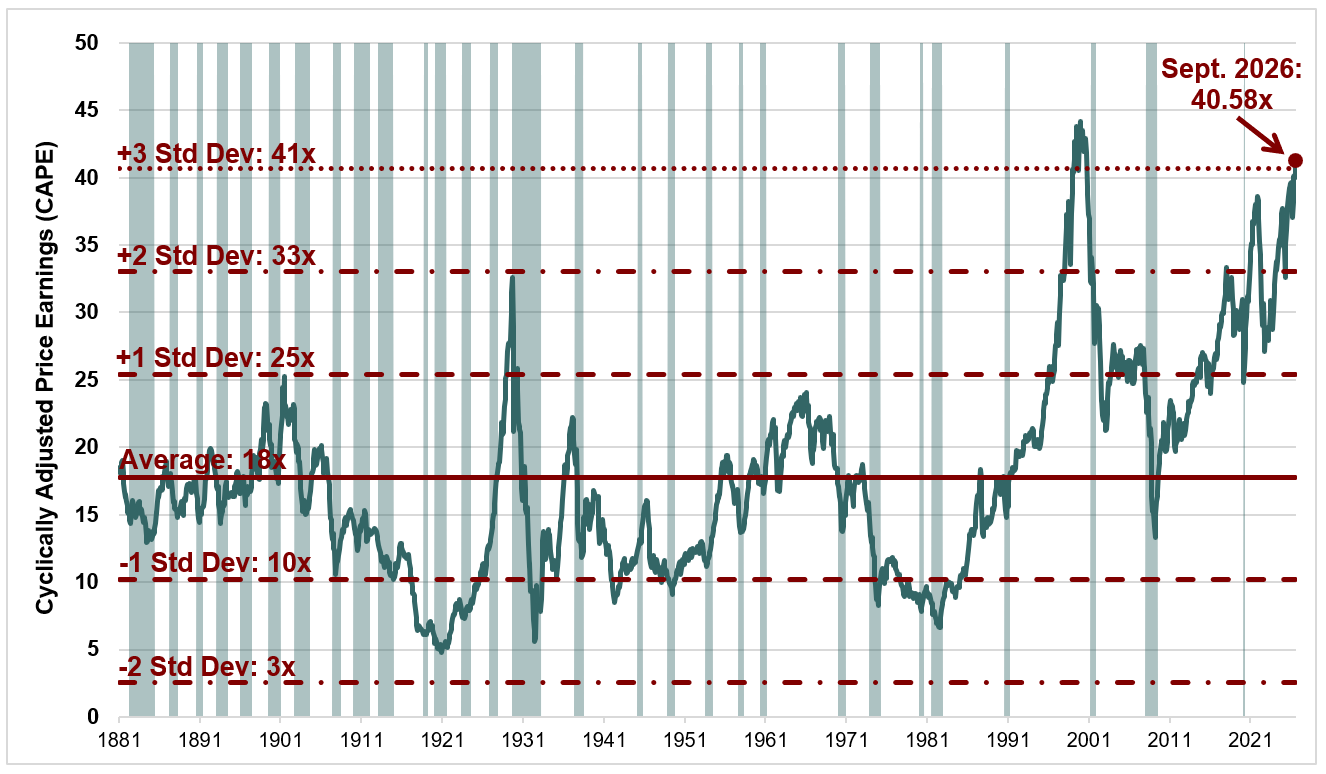
Source: Robert Shiller, Yale University; SaratogaRIM calculations. Monthly observations, January 1881–September 2026. Shaded areas represent recessions. See Disclosures.
By Robert Shiller’s cyclically adjusted measure, U.S. equity valuations today reside in exceptionally rare historical territory. The September 2026 CAPE reading of approximately 40.58 sits near the three-standard-deviation threshold calculated over the full period shown. In a monthly series beginning in 1881, only 20 prior months recorded valuations higher than those we see today. Nineteen of them occurred during the period surrounding the peak of the dot-com boom; the remaining month was August 2026. Even the all-time high was only a little more than three and a half points above today’s lofty level, while the peak preceding the 1929 stock market crash was roughly eight points lower.
That may sound ominous, but it should not be interpreted as a market forecast. Valuation has never been a reliable way to predict what markets will do next month, next year, or even over several years. Expensive markets can become more expensive. The dot-com experience itself demonstrated just how far valuations can extend beyond historical precedent, and how long they can remain there. At the market level, many traditional valuation metrics have indicated that stock prices have been expensive for a very long time.But the inability to use these metrics to time markets doesn’t render valuation irrelevant.
Figure 9: Starting CAPE (1881 to 2016) vs Subsequent 10Y Real Return (1881 to 2026)
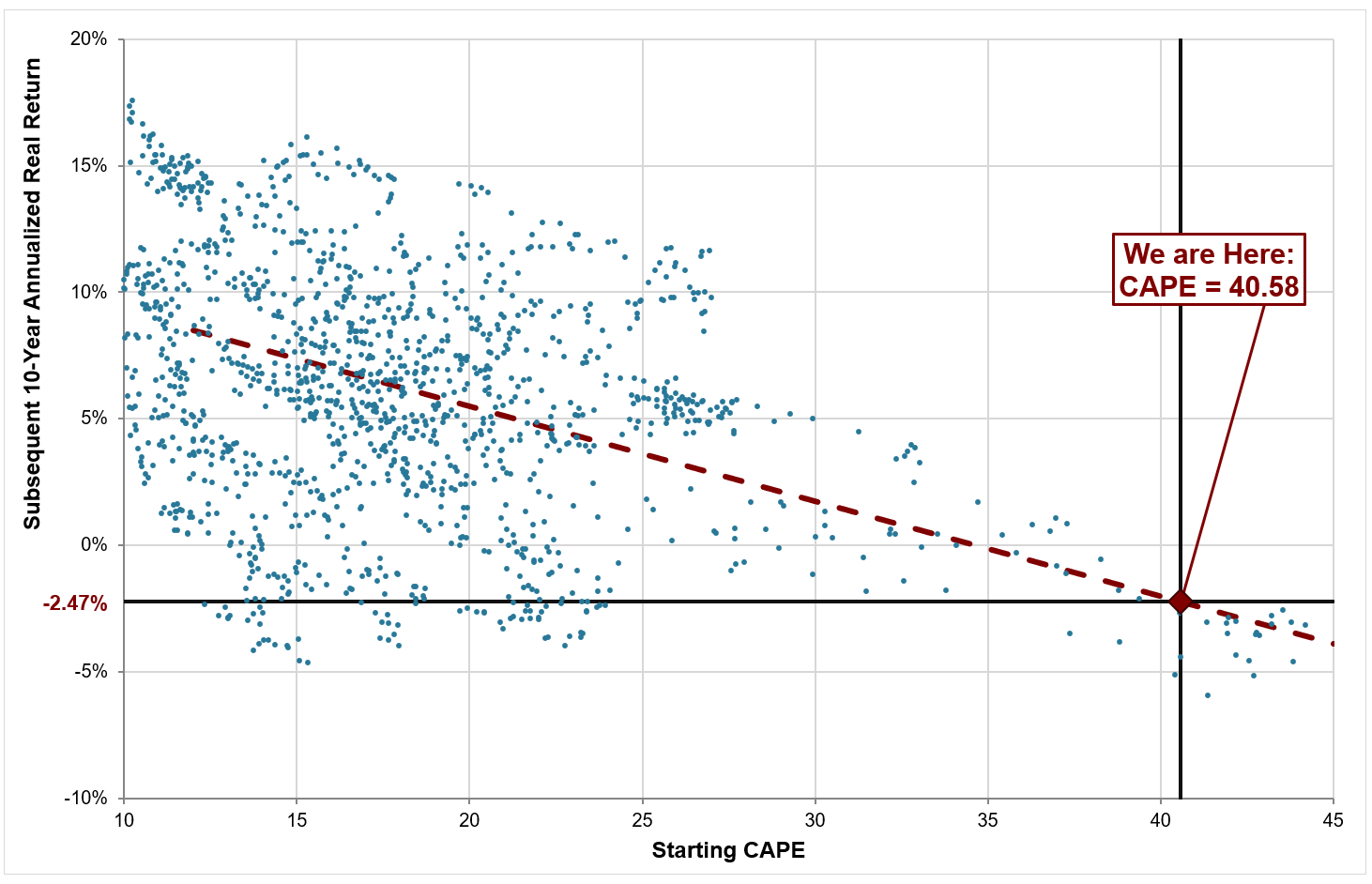
Source: Robert Shiller, Yale University; SaratogaRIM calculations. Historical monthly observations, January 1881-September 2016; September 2026 CAPE shown separately at its regression-implied return. See Disclosures.
Over long periods, starting valuation has historically been meaningfully related to subsequent returns. The relationship is far from perfect – nothing about the future is – but investors who began at lower valuations have generally experienced higher subsequent long-term real returns, while investors who began at elevated valuations have generally experienced lower ones. That should not be surprising. The price we pay determines the prospective return available from whatever future ultimately arrives.
In our 2025 Q3 Report, Through Time and Tide, I described valuations as being near the most extreme levels in history while other risk cushions, including the equity risk premium and credit spreads, had compressed dramatically. I also made the qualification that matters just as much today: none of this is a market forecast. It’s just an objective description of the investment environment around us today.
It’s Not Just the CAPE
The CAPE is particularly useful because of its historical relationship with subsequent long-term returns, but no valuation measure is perfect. Its ten-year averaging period can make it slow to reflect structural changes in earnings. Accounting standards evolve. Industry composition changes. Interest rates matter. Profitability changes. Reasonable people can disagree about what constitutes an appropriate valuation in a changing economy. That is why it makes little sense to rely upon any single measure of valuation when many others are available to us.
Figure 10: S&P 500 Valuation – Current Percentile Ranking Relative to History by Metric (as of September 2026)
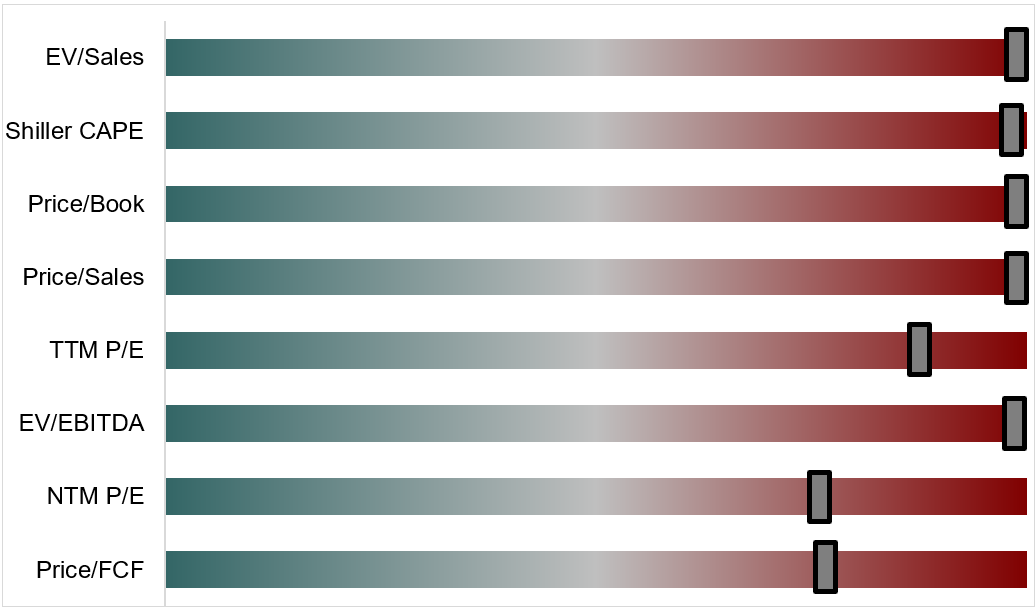
Source: Strategas, FactSet, Bloomberg, Robert Shiller, SaratogaRIM. See Disclosures.
Looking across a range of commonly used valuation measures – price-to-earnings, price-to-sales, enterprise value relative to sales and EBITDA, price-to-book, free cash flow, CAPE, and forward earnings – the precise degree of elevation varies, but the broader message is difficult to miss. U.S. equity valuations reside near the expensive end of their historical ranges across a remarkably broad set of measures.
The three less-extreme measures are particularly interesting. Each uses current or expected earnings or cash flow in the denominator. Those denominators warrant close attention given the extraordinary surge in earnings and cash flows accompanying the ongoing AI capital-expenditure boom we have examined throughout this series.
That doesn’t make the current earnings or future estimates wrong. But it does remind us what is hiding inside the denominator. As we explored in Understanding Capital Investment Cycles, the revenues and profits generated by a capital boom can appear quickly, while many of the costs associated with the investments emerge more gradually. To the extent today’s extraordinary earnings and cash flows are boosting the denominators of these valuation measures, they are also making current valuations appear less extreme.
Figure 11: Forward 10-Year Real Total Return Projections for the S&P 500
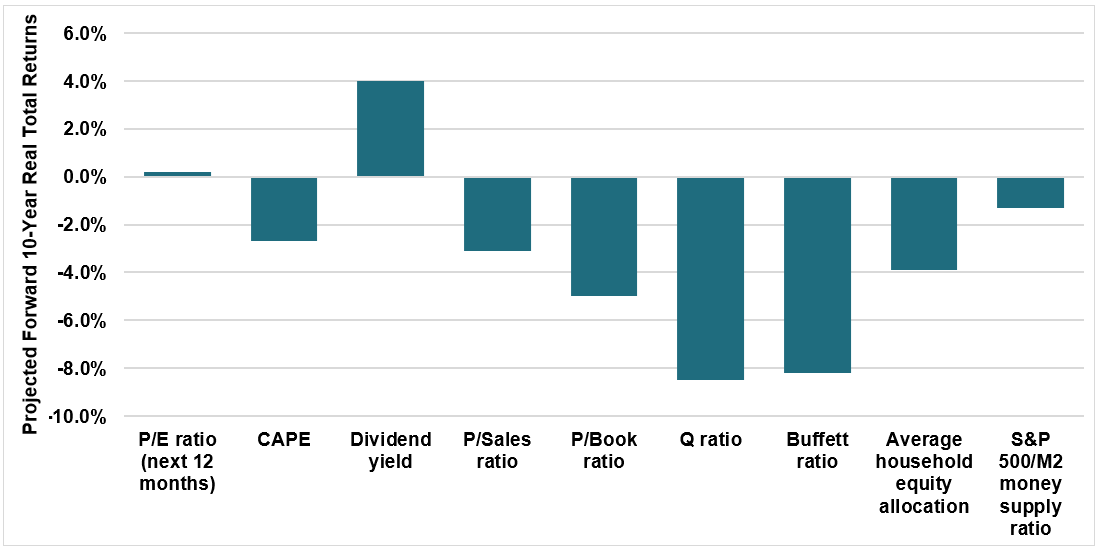
Source: Marketwatch, Hulbert Ratings, SaratogaRIM. Projected return based on past correlations between indicators and the S&P 500. See Disclosures.
These measures can also be viewed through a different lens: what have similar starting conditions historically implied for subsequent long-term returns? The chart above applies the historical relationships between nine different indicators and the S&P 500’s subsequent 10-year real total return. The estimates vary considerably, which should again remind us of the limitations of any particular model. But the broader message remains remarkably consistent. Eight of the nine measures project real returns ranging from roughly flat to deeply negative, while only the dividend yield metric points to a positive outcome. Across all nine measures, the average projected real return is negative 3.2% annually over the next decade.
Once again, none of this should be taken as a forecast, and I can’t emphasize that enough. Historical relationships can and do change, and there is no obvious reason to expect the next ten years to resemble any particular historical period exactly. But disagreement about the precise magnitude of prospective returns is different from disagreement about the signal. Measures built from earnings, sales, book value, replacement cost, market capitalization, money supply, and investor positioning approach the question from very different angles. Today, nearly all of them point toward unusually modest prospective long-term returns from these starting levels.
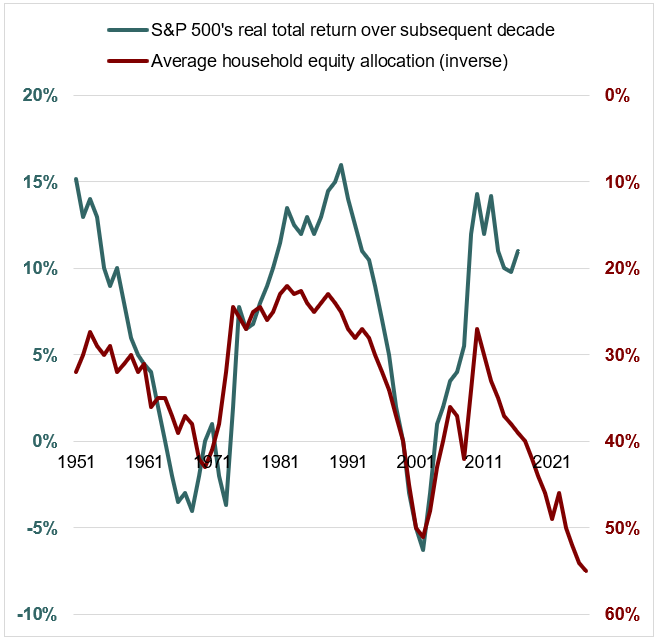
One measure in the preceding chart deserves a closer look. Average household equity allocation approaches the question from a very different direction than traditional valuation measures. Rather than comparing stock prices with earnings, sales, book value, or some other measure of underlying fundamentals, it simply asks how much household financial wealth is already invested in equities.
Figure 12: Average Household Equity Allocation vs S&P 500 Since 1951
Source: Marketwatch, Hulbert Ratings, St. Louis Federal Reserve, S&P Global, SaratogaRIM. See Disclosures.
The chart above compares that allocation with the S&P 500’s subsequent 10-year real total return. Note that the right-hand axis is inverted, so a falling red line represents a rising allocation to equities. The historical relationship is striking. Of the nine indicators examined on the previous chart, average household equity allocation has demonstrated the strongest statistical relationship with subsequent 10-year real total returns.
When households have held relatively large portions of their financial assets in stocks, subsequent 10-year real returns have generally been lower. When equity allocations have been more modest, subsequent returns have generally been higher. Today, household equity allocations stand at their highest level in the history shown.
There are several possible reasons for this relationship. Rising stock prices mechanically increase equities as a percentage of household wealth, but human behavior may contribute as well. Sustained market gains like we’ve seen over recent years can increase confidence, make risk appear less threatening, and encourage investors to commit still more capital to what has already worked. In that sense, household equity allocation may reflect more than valuation alone. It may also tell us something about investor enthusiasm and how thoroughly that enthusiasm has already been built into market prices.
We cannot say that high household equity allocations cause low subsequent returns. But the relationship does provide another perspective on the environment in which investment decisions are being made today. Equity valuations are historically expensive across a broad range of measures, the long-term prospective returns implied by many of those measures are unusually modest, and investors have rarely had more exposure.
The Price of Uncertainty
This brings us back to a question that has run throughout the Latticework Series: how much compensation should we require for bearing uncertainty?
Traditional financial theory teaches that bearing greater risk should require greater expected return. Whatever disagreements we may have with the way some models define or measure risk, we fully agree with this underlying intuition. Uncertainty should have a price.
An investor committing capital for a longer period should generally require compensation for the additional uncertainty associated with time. A lender bearing the possibility of corporate default should require additional compensation beyond that available from a government borrower. And an equity investor bearing the residual uncertainty of business ownership should generally require still greater prospective return. The measures differ, but the underlying principle shouldn’t.
And this is what makes the financial world around us today so intriguing. Across very different parts of the capital markets, investors do appear willing to accept historically modest compensation even though the range of plausible future economic outcomes appears unusually wide. That is the toughest puzzle of them all.
Figure 13: 10-Year Term Premium (Using the Adrian, Crump & Moench Model from the New York Federal Reserve)
Source: Bloomberg, New York Federal Reserve, Bianco Research, SaratogaRIM. See Disclosures.
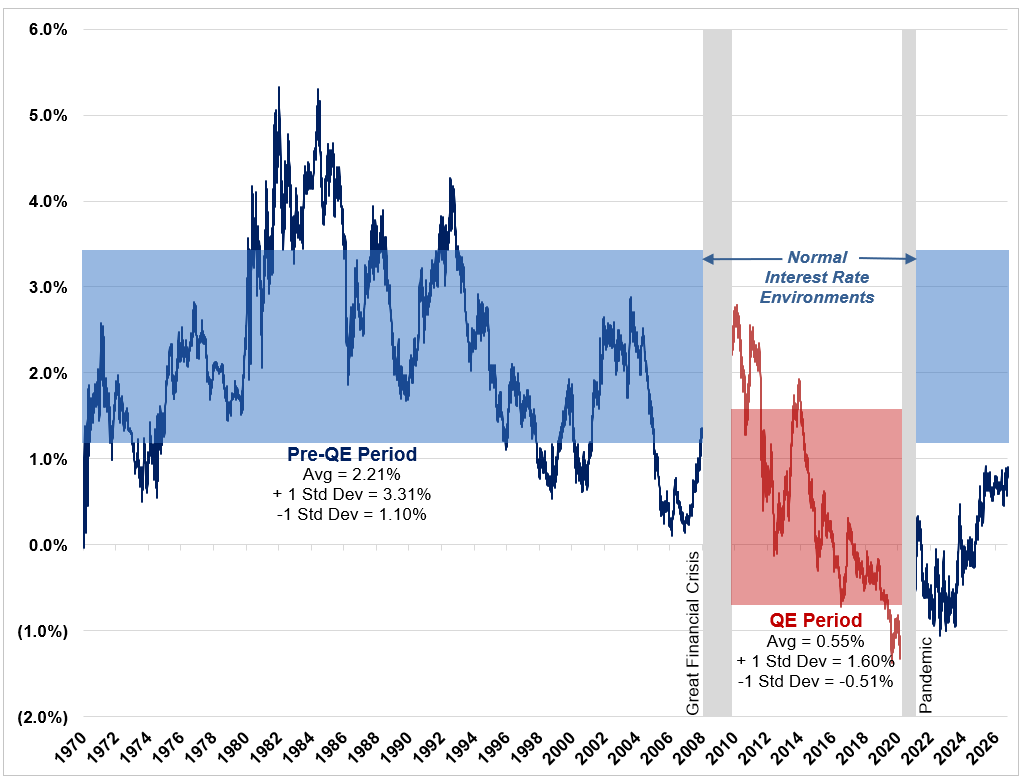
The term premium represents the additional compensation investors require for committing capital to longer-term government bonds rather than continually reinvesting in shorter-term securities. As the chart illustrates, estimates of that premium remain well below the levels that prevailed before the era of quantitative easing, despite considerable uncertainty surrounding inflation, fiscal policy, government borrowing, geopolitical uncertainty, and the future path of interest rates. Perhaps investors will ultimately prove justified in accepting such modest compensation. But the contrast between the breadth of today’s uncertainty and the historically compressed compensation for bearing it is striking.
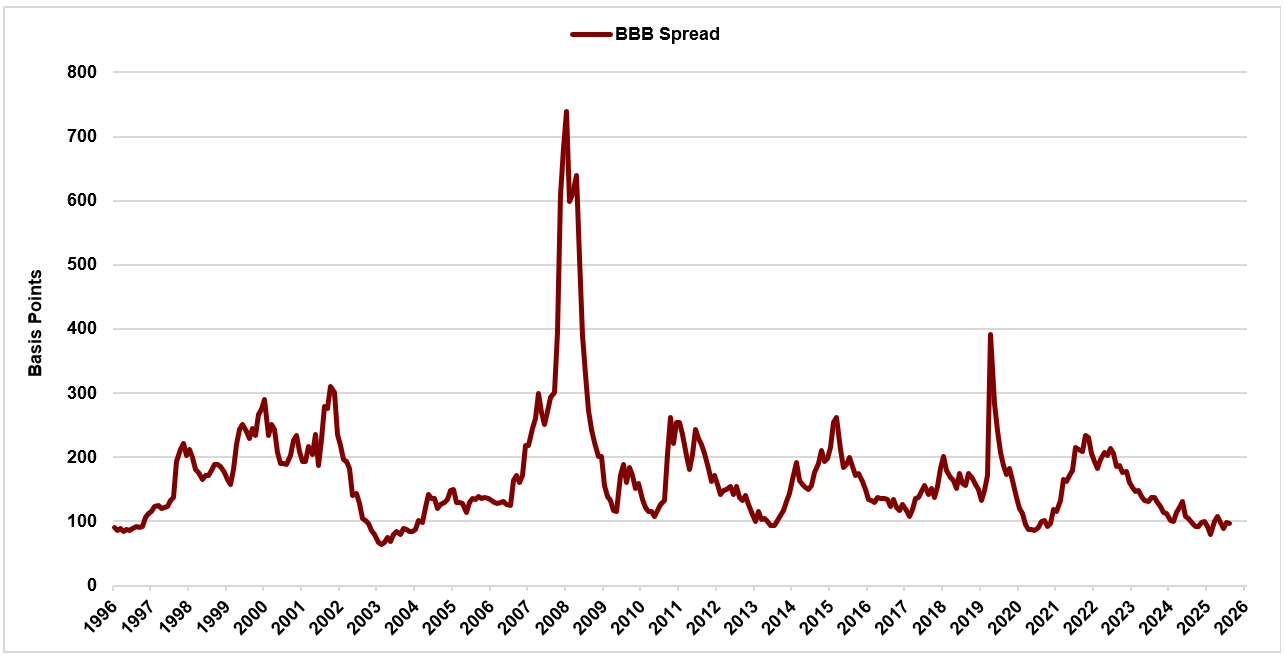
Corporate credit spreads provide an even more direct way to observe how little compensation investors are demanding for bearing incremental uncertainty.
Figure 14: BBB Corporate Credit Spread Above the U.S. Treasury Yield
Source: FactSet, SaratogaRIM. See Disclosures.
Credit spreads measure the additional yield investors demand for lending to corporations rather than the U.S. government. Investment-grade spreads currently sit near their tightest levels in almost 30 years, while high-yield spreads are similarly compressed. In both markets, the incremental compensation for bearing corporate credit risk remains historically thin.
Equities present a more difficult challenge because the compensation investors receive for bearing the uncertainty of business ownership cannot be observed as directly. In credit markets, the yields and spreads are right there in front of us.
Figure 15: Cyclically Adjusted Equity Earnings Yield Less the 10-Year Treasury Yield
Source: FactSet, Robert Shiller, SaratogaRIM. See Disclosures.
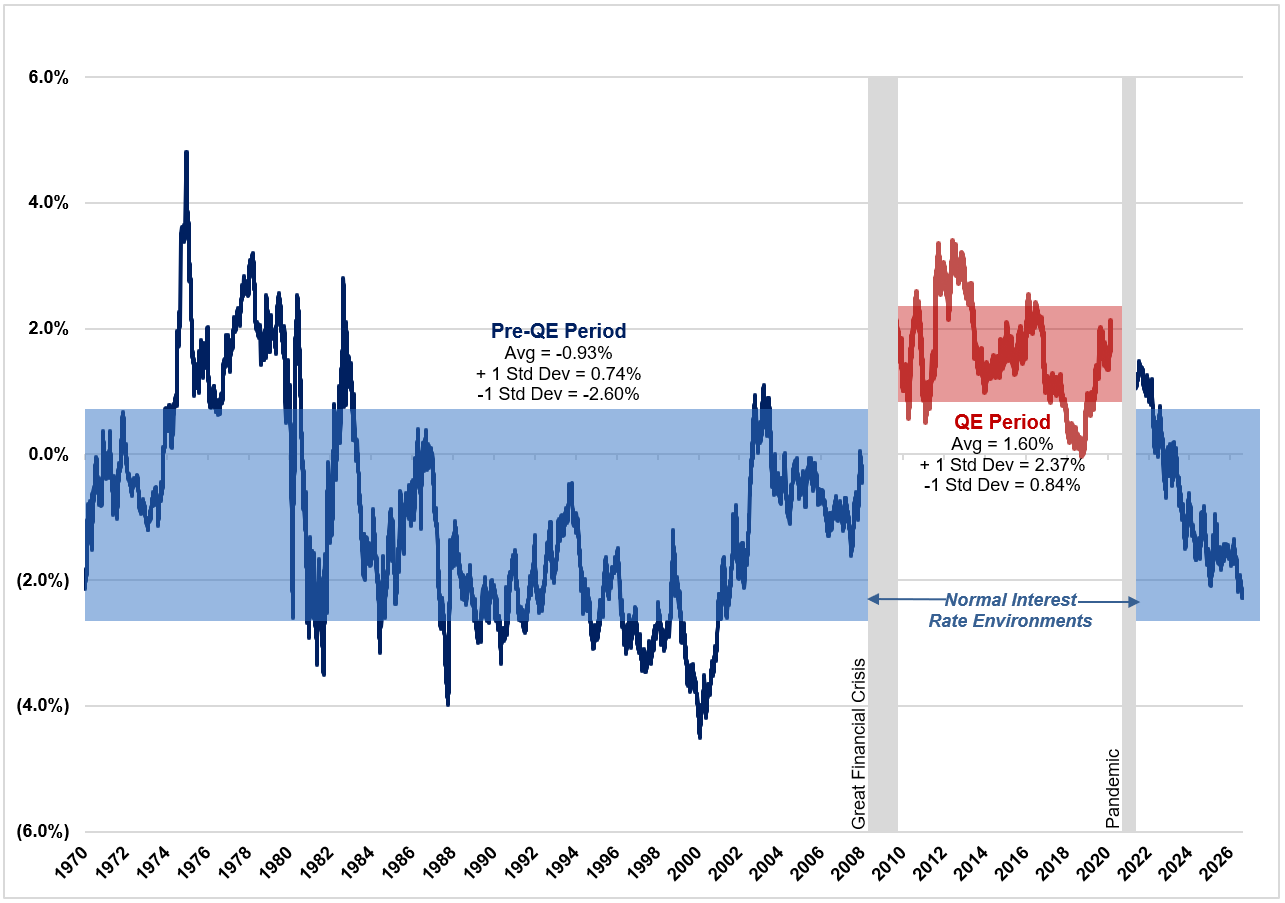
The cyclically adjusted earnings yield is the inverse of the CAPE ratio we examined earlier. The chart subtracts the nominal yield available on 10-year Treasuries from that earnings yield. The resulting spread provides a simple measure of the incremental earnings yield equities offer relative to Treasuries: a wider spread means more, while a narrower – or negative – spread means less.
The comparison is admittedly imperfect because the earnings underlying the cyclically adjusted earnings yield have been adjusted for inflation, while the Treasury yield is nominal. Ideally, we would compare the cyclically adjusted earnings yield with the yield on 10-year Treasury Inflation-Protected Securities, providing a more apples-to-apples comparison. TIPS, however, were not introduced until 1997, so using them would eliminate much of the historical context the chart is intended to provide. It should therefore not be interpreted as a directly measurable equity risk premium, but rather as a simple valuation comparison between the earnings yield available on equities and the nominal yield available on Treasury bonds.
The post-Global Financial Crisis period shown in red requires particular attention. Interest rates during those years were extraordinarily low, supported by near-zero short-term rates and large-scale Federal Reserve asset purchases more commonly known as quantitative easing, or QE. With Treasury yields so heavily suppressed, equities could trade at historically elevated valuations, and therefore relatively low cyclically adjusted earnings yields, while still offering meaningful incremental earnings yield relative to government bonds. Today’s narrow spread has emerged under very different circumstances. Treasury yields have risen materially from their extraordinarily low post-crisis levels, while elevated equity valuations have kept the cyclically adjusted earnings yield low. As a result, the incremental earnings yield equities offer over 10-year Treasuries has fallen to levels not seen since the dot-com era.
We have discussed all of these measures before. None of them are perfect, and they should not be treated as interchangeable. But taken together they tell a remarkably consistent story. Across duration, corporate credit, and equity markets, the compensation available for bearing uncertainty appears unusually modest.
Meanwhile, the degree of uncertainty in the financial world around us today feels unusually high. Artificial intelligence is reshaping industries at an extraordinary pace. The capital required to build the necessary infrastructure is enormous. Government debt burdens are already historically elevated across much of the developed world, and persistent fiscal deficits continue to push both debt and future financing needs relentlessly higher. Longstanding geopolitical relationships are fragmenting. Global supply chains are being reorganized. Demographic pressures are reshaping labor markets and patterns of saving and investment. The future paths of inflation, interest rates, productivity, corporate profitability, and the cost of capital all remain unusually uncertain.
The range of plausible outcomes may be wider than it has been in quite some time. Yet across the board, the compensation available for bearing uncertainty remains historically low. Here’s that puzzle again: How can both things be true?
One possible answer is that today’s pricing could prove entirely rational. But for that to happen, an awful lot would have to go right. The extraordinary investment in artificial intelligence would need to produce substantial productivity gains, corporate earnings would need to grow sufficiently to justify today’s elevated valuations, and the enormous amounts of capital being committed would need to earn adequate returns despite a potentially higher cost of capital. Inflation and interest rates would also need to remain sufficiently contained to keep that higher cost of capital from overwhelming any gains. None of that can be ruled out as impossible. A more plausible explanation may be much simpler: After all, we’re only human.
Markets Are Human Systems
Behavioral finance offers an intuitive answer: It’s the people, stupid. Full apologies to James Carville.
Recent years have witnessed an extraordinary expansion of speculative activity across financial markets. Retail investors routinely trade zero-day-to-expiration options whose entire value can disappear within hours. Leveraged single-stock exchange-traded funds allow participants to amplify daily gains and losses on individual companies. Cryptocurrencies, meme stocks, and commission-free trading have made speculation extraordinarily accessible. Prediction markets are now being integrated directly into brokerage platforms; Robinhood says they have become the fastest-growing business in the company’s history. At the same time, online sports betting has exploded in popularity, further blurring the psychological distinction between investing, speculation, and outright gambling for many participants. At his final Berkshire Hathaway annual meeting as chairman in 2026, Warren Buffett left investors with an appropriate warning on his way out the door: “We’ve never had people in a more gambling mood than now.”
Speculative activities are no longer merely competing for attention. They are increasingly competing for the same dollars and occupying the same psychological space as investing. A recent Betterment survey cited by Bloomberg found that more than a quarter of Gen Z investors now consider sports betting part of their long-term financial strategy, while more than half of younger investors said they had redirected money originally intended for investing into sports betting during the past year.
We explored the neurological foundations driving these kinds of behavior in The Neuroscience of the Sirens’ Song. The anticipation of uncertain rewards engages the brain’s dopamine system and some of the same neural circuitry whether the potential payoff comes from a stock, an option, a cryptocurrency, or a wager on a football game. The financial instruments may differ, but the human brain's response doesn't seem to.
Even so, none of this can definitively prove that markets are irrational. It does, however, suggest that a meaningful amount of market activity is being motivated by forces having little to do with any careful estimation of future cash flows. Market prices ultimately reflect the collective actions of everyone transacting in the market. Prices are influenced by disciplined long-term investors estimating intrinsic value, but they are also influenced by traders pursuing momentum, speculators seeking quick gains, institutions managing career and benchmark risk, algorithms responding to price movements, and individuals whose objectives may have little to do with the long-term economics of the underlying businesses at all.
For professional investors, these dynamics can create dangerous incentives. Departing materially from a benchmark or prevailing consensus creates the possibility of looking wrong for an extended period even when the underlying judgment ultimately proves correct. Clients can leave, assets can disappear, and careers can suffer long before the investment thesis has had time to play out. The incentive to remain close to the consensus can therefore become strongest precisely when independent judgment might matter most. This is one reason precommitment to first principles matters. When the temptation to protect short-term relative performance conflicts with our obligation to protect against permanent impairment of capital, the latter has to come first.
These kinds of pressures can become especially powerful during periods of sustained optimism. Traditional financial theory suggests that rational investors should demand greater compensation for bearing greater uncertainty. Human behavior can sometimes turn that relationship on its head.
As prices rise and favorable outcomes persist, the future itself can begin to feel less uncertain simply because markets have been treating investors kindly. Recent experience shapes expectations, confidence rises, and risks that once seemed important can gradually recede from view. The underlying uncertainty needn’t have changed at all. Only our perception of it has.
This may help explain why markets periodically appear to offer surprisingly little compensation for bearing uncertainty even when uncertainty itself remains unusually high. Pricing the Unknowable established the underlying principle: uncertainty should command compensation. Behavioral finance adds an important complication. The human beings setting market prices may not always demand that compensation either rationally or consistently. The financial world around us today appears to offer a particularly vivid example.
The Market Determines the Price, Not the Uncertainty
This distinction may be the most important one in this essay. The amount of uncertainty surrounding an investment and the compensation markets offer us for bearing it are two entirely different things.
Markets determine the latter. They do not determine the former.
The future does not become safer because investors are willing to pay more for it. A business doesn’t become more certain because its stock price has risen. A borrower doesn’t become immune to default simply because investors are willing to lend to it at a narrower spread. Long-term interest-rate uncertainty doesn’t disappear because investors are willing to accept little term premium for bearing it. Price tells us what people are willing to accept. It does not tell us what the future is going to deliver.
Sometimes fear causes investors to demand enormous compensation for uncertainty. Prices fall, credit spreads widen, risk premiums rise, and expectations become sufficiently pessimistic that investors may ultimately be rewarded even if the future proves merely adequate.
At other times, optimism can produce the opposite result. Prices rise, spreads narrow, risk premiums compress, and increasingly favorable assumptions become embedded in the pricing structure. The better recent experience has been, the easier it becomes to imagine that favorable conditions will persist.
At Jackson Hole in 2005, Alan Greenspan highlighted the danger in such environments when he warned that “history has not dealt kindly with the aftermath of protracted periods of low risk premiums.” He offered no timetable, but recognized that investor confidence can suppress the compensation demanded for bearing risk with no corresponding reduction in underlying uncertainty.
This is one reason the relationship between uncertainty and prospective return can become so counterintuitive. The moments when the future feels most dangerous can sometimes offer the greatest compensation for bearing it, while the moments when the future feels safest can sometimes offer the least.
What Can We Actually Know?
Nothing I’ve written about across this series can definitively prove that markets are wrong today. Perhaps artificial intelligence will generate productivity gains far greater than we can presently imagine. Maybe the extraordinary capital investment boom underway today will produce returns more than sufficient to justify it. Perhaps corporate earnings will grow rapidly enough to make today’s valuations appear reasonable in retrospect. Maybe credit losses will remain low. Perhaps inflation will finally recede, fiscal pressures will somehow prove manageable, and maybe long-term interest rates will even settle comfortably back to levels investors are more at ease with.
All of those outcomes are theoretically possible. So are far less favorable outcomes, including some we’ve almost certainly failed to imagine.
We can’t know which future will arrive. Recognizing that limitation should make us cautious about declaring that the market has clearly gotten the answer wrong simply because today’s valuations stand near historical extremes. But the opposite conclusion may make even less sense. We definitely shouldn’t assume that the market must be right simply because current prices were collectively produced by millions of people.
Markets are extraordinary mechanisms for aggregating information. They deserve our respect for that. When our analysis differs materially from the market’s judgment, we should always ask what the market may understand that we don’t. But humility cuts both ways. The fact that we might be wrong does not mean the market must be right.
Markets possess no independent intelligence separate from the people who comprise them. Their extraordinary ability to process information coexists with the behavioral characteristics of the human beings supplying that information and acting upon it. The crowd can be wise. It can also become optimistic, fearful, extrapolative, self-reinforcing, and occasionally completely detached from the fundamentals it is supposedly discounting. Those two observations are not contradictory. They describe one and the same market.
Only Judgment Remains
This leaves anyone seeking certainty in an uncomfortable place. Security Analysis isn’t omniscient. Markets cannot be relied upon to price an uncertain future accurately. Behavioral finance can help us understand why prices may sometimes diverge from fundamentals, but it can’t tell us precisely when that divergence has occurred or how long it will persist.
There is no magic formula waiting at the end of this discussion to relieve us of the burden of judgment. That’s the most important lesson.
The Latticework Series has viewed the financial world around us through the lenses of behavioral finance, neuroscience, microeconomics, financial statement analysis and accounting, credit analysis, financial theory, and Security Analysis because no single discipline is capable of explaining everything. Each provides an incomplete perspective. But together they may allow us to see patterns we might otherwise miss. At the end of the day, though, decisions still have to be made.
We have to decide which businesses we are willing to own, what uncertainties we are willing to bear, how much we are willing to pay for them, and how much confidence to place in our own analysis relative to the collective judgment of the market. Sometimes we have to make those decisions when nearly everyone around us seems hell-bent on marching in the other direction.
These kinds of decisions can be particularly difficult in environments like the one around us today. Uncertainty looks unusually high, while the compensation available for bearing it appears unusually modest across not just the capital markets more broadly, but even within a significant chunk of our investable universe. Many measures of equity valuation sit near the upper end of historical experience. Credit spreads are compressed. More broadly, risk premiums in today’s market are priced to provide relatively little cushion.
The water’s fine, come on in.
There’s no crystal ball that can tell us what the future holds. We can analyze the businesses we own, consider the uncertainties they face, evaluate the prices we are being asked to pay, and form our best judgment about whether we are being adequately compensated for the risks we are taking. But eventually analysis has to end and decisions have to be made.
That would be difficult enough if we were investing only our own money. We are not.
The capital we manage represents the accumulated savings, work, sacrifice, plans, and expectations of the people who have entrusted it to us to guard and grow it. They do not need us to know a future that cannot be known. But they have every right to expect us to exercise judgment thoughtfully even when that future refuses to reveal itself – and especially when prevailing market prices and the behavior of everyone around us make doing so most difficult.
This responsibility changes the nature of the question. It leaves us with one that is ultimately even more important than what we believe: How should our belief system govern the way we manage our clients’ money?
That is a question of stewardship.
Editor’s Note
This essay is part of our ongoing Latticework Series, which examines the financial world around us today through the lenses of multiple disciplines. The previous essay added the lens of Security Analysis and explored how business quality, financial strength, margin of safety, and sufficient diversification can provide resilience when the future cannot be known with certainty.
This essay turns from the analysis of value to the formation of price. Markets are extraordinary mechanisms for aggregating information, but the prices they produce ultimately reflect the collective judgments of human beings. Behavioral finance helps us understand how optimism, fear, extrapolation, social reinforcement, and other influences can affect those judgments – and why the compensation markets offer for bearing uncertainty may not always correspond to the uncertainty investors actually face.
Complex investment problems rarely yield to a single discipline. Our objective is not to replace one framework with another, but to understand where each contributes insights the others cannot.
The final essay in this series, Stewardship, will bring these different perspectives together. If the future cannot be known with certainty, analysis cannot eliminate the possibility of being wrong, and markets cannot be relied upon to price uncertainty perfectly, the ultimate challenge is one of judgment. Stewardship will ask how that judgment should govern the way we manage capital entrusted to us by our clients.